Saturday, 9 May 2020

19 posters in Sheffield, England

Programmes at risk as more NGOs face closure

6 MAY 2020
More NGOs face cuts and closures as the volatile Covid-19 crisis continues. Our latest survey shows that 50 out of 116 organisations won’t survive longer than six months without additional funding. 
This is an increase from 34 NGOs who said they faced closure after six months in our previous survey in late March. We surveyed our members again in late April to get more information on the repercussions of Covid-19 on international NGOs’ finances and operations. 
NGOs are doing what they can to continue supporting the world’s most vulnerable people. But as financial pressures increase, 53% of respondents said that they have already or are planning on cutting programmes. 
Here are the key findings from our survey of 116 CEOs of Bond members (representing over a quarter of our membership), ranging from small to large organisations. 

More NGOs face closure in the next six months  

43% of respondents said that their organisations will fold within six months unless they receive additional funding from other sources, whether public fundraising, institutional donors or the UK government. CAF’s latest survey shows that only 13% of British people are likely to donate to international charities, compared to 28% who are likely to donate to national charities and 48% who would donate to local charities. 
DFID is providing some flexibility to those who already hold grants or contracts to help them cope with the effects of the virus on their programmes, although further clarification is needed. Only a quarter of Bond’s members receive direct funding from DFID currently.

Your always in my mind Baby Baysan Ayoub

Oh  Alaah  be   gracious  towards  me  in the  matter  of  my offsrings

UK aid for Haiti being loaded onto a Royal Fleet Auxillary ship

CREDIT: DEPARTMENT FOR INTERNATIONAL DEVELOPMENT/RUSSELL WATKINS - ATTRIBUTION 2.0 GENERIC (CC BY 2.0)

Why we need more transparency in aid spending

16 JANUARY 2020
AUTHOR: KATE OLIVER
The UK currently spends 0.7% of its gross national income (GNI) on overseas aid, something which has been enshrined in law since 2015. The UK spends this money in line with OECD Development Assistance Committee (DAC) aid rules. 
As per the OECD DAC’s definition, aid spending should ensure that “the economic development and welfare of developing countries its main priority and it is not advancing the business interests of the donor.”
As part of a mechanism to protect UK aid, and to keep ensuring that tax payers’ money was going to those who need it the most, the UK government set a target that any government department responsible for spending UK aid would be required to “introduce greater transparency” into their work. 
This aid strategy would help increase efficiency and effectiveness of aid spending, and increase cooperation between departments and share what works. The government also set out a commitment to ensure that  all UK government departments would be  ranked as “good’ or “very good” in the international Aid Transparency Index (ATI) by 2020. 
Disappointingly, the 2020 ATI has found that five years after the aid strategy which committed departments to take transparency seriously, only three out of 10 spending departments have met the target. 
More alarming still, the evidence shows that the Foreign and Commonwealth Office (FCO), the second largest spender of UK aid money, only recently got a rating of “fair”. While this represents an improvement on previous years’ grading, it falls well short of the UK government’s own commitment to having all departments rated as “Good” by 2020. 

Transparency doesn’t exist for transparency’s sake

Transparency is a precursor to making aid work better for the poorest. If we can’t show people where, when or how UK aid is being used to reduce poverty around the world, we can’t hope to improve the standards of our programming and results. 
Transparency is not another condition applied to UK aid to make it more complicated or harder to spend. Commitments to increase transparency exist for a reason. 
The Busan Partnership Agreement 2011 states: “Transparency and accountability to each other, mutual accountability and accountability to the intended beneficiaries of our co-operation, as well as to our respective citizens, organisations, constituents and shareholders, is critical to delivering results. Transparent practices form the basis for enhanced accountability.”
Put simply: it is so we know who is being helped, what impact it is having on people’s lives, and whether or not we should continue with our work. It is how we encourage others to help, by sharing data and expertise for higher-quality programme delivery. And it is how we stay accountable not just to the people we are helping, but the people whose money we are using to do so: the British taxpayer.

Saturday, 2 May 2020

UN SRSG Mohamed Ibn Chambas - COVID-19 & Conflict in West Africa & the Sahel
Photo Credit: Dominic Chavez/World Bank
Date and Time: Friday 24th April, 11am
Webinar via Zoom
The United Nations has all hands on deck to fight a once-in-a-lifetime pandemic. In West Africa and the Sahel, the United Nations is mobilised on all fronts alongside local authorities and the populations in their fight against the spread of COVID-19, with dedication and solidarity.
At this online event, Mr. Mohamed Ibn Chambas, UN SRSG for West Africa & the Sahel and Head of UNOWAS will discuss the impact of the COVID-19 pandemic and its potential effect on both political stability and economic livelihoods.
Register

The Future of Africa and COVID-19

Date and Time: Wednesday 29th April, 11am
Webinar via Zoom
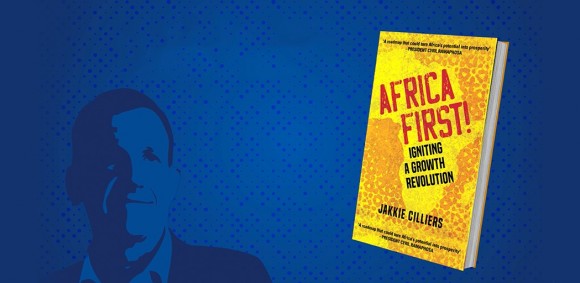
In this special book launch, we look at what the future holds for the African continent as it faces the Coronavirus crisis that has impacted the whole world.

Dr. Jakkie Cilliers – chairman of the Board and Head of African Futures & Innovation at Institute for Security Studies – has just published his latest book ‘Africa First! Igniting a Growth Revolution’ and will join us from South Africa to discuss how the COVID-19 pandemic impacts on the shape of that future.
Register
From the APPG for Africa
COVID 19: Early community engagement & accurate communication is crucial
 
The APPG Chairs have recently written a letter to the Secretary of State for International Development to press the importance of early community engagement when supporting African countries responding to COVID 19.  This draws on the findings of our inquiry of 2016 into preparedness for future health crisis and the Ebola outbreak.
 
Read report

Friday, 1 May 2020

Greetings!
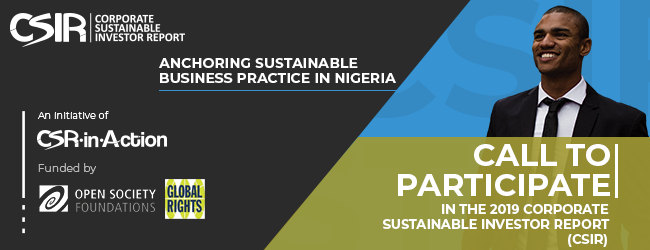
The Corporate Sustainable Investor Report (CSIR) is a comprehensive corporate compendium which analyses sustainability activities of businesses all over Nigeria, inclusive of indigenous and multinational businesses, and is modelled after international reports on sustainable investment and governance.

Now in its forth run, the CSIR is a compelling, widely-circulated and utilised resource for investors, financial analysts, sustainability enthusiasts, business managers, government agencies, academia and the general public.
Why you need to participate?
  • Participation and showcase is free!
  • Get a chance to be reported in Nigeria’s premier, widely disseminated and inclusive corportate compendium on sustainability
  • Create the right impression about your organisation
  • Creatively express your financial, non-financial and ESG practices
  • Take advantage of our over 30,000 email subscribers and multiple international platforms
  • Extend your organisation’s reach both locally and internationally
  • Prime opportunity to attract attention of potential investors, customers and new business globally.
Eligibility criteria
You are eligible to participate if your meet any two of the under-listed criteria:

  1. You possess a CSR and/or sustainability report.
  2. You have an annual revenue of 500 million naira and above.
  3. You are enlisted on The Nigerian Stock Exchange.
  4. You have been in operation for 4 years or more.
If you are eligible, click the 'participate' button below to send an email to the team who will then send you an access code to fill the questionnaire.

For more information about the CSIR, visit www.csr-in-action.org/csir or reach out to Dami Adewuni on 09062634133 or Dami Vera-Cruz on 09062634111. Alternatively email csir@csr-in-action.org.

The COVID-19 pandemic has evoked extraordinary and unpredictable situation the world over, with concerns steering towards supply-side manufacturing to decreased business in the services sector.

The gravity of the pandemic and its resultant effect on individual and community affairs have therefore made it imperative for people to find survival mechanisms.

To this end, CSR-in-Action, in conjunction with Zenera Consulting have launched an audit into corporates’ investment towards fighting the scourge. This is while calling on all hands to be on deck for the benefit of delivering the much needed brand capital.

To achieve this, we ask that you take a few minutes to answer the questions therein. Data gotten from this survey will be organised into a report that will be pitched to corporate bodies.

Please feel free to share with your subsidiaries

Thursday, 30 April 2020

Has US foreign policy in recent years surprised the Chinese leadership?
Yes, and that’s exactly the point I made in my International Affairs article. Not only did Chinese officials and established scholars grossly underestimate the deep frustrations with China among America’s policy, business and academic elites, they also had a false sense of stability in the relationship that they attributed to the Sino-US economic interdependence. They also misunderstood Trump the individual, believing that he could be appeased and mollified by Chinese ‘buy buy buy’. As is clear by now, his administration has been ramping up more pressure on China across the board and there are China hawks across the political spectrum.
How did the Chinese leadership respond to Trump’s election victory?
Ahead of the 2016 US election, the majority opinion within the Chinese foreign policy establishment could be summarized as ‘anyone but Clinton’. Many held deep antipathy toward former secretary of state Hillary Clinton for her hawkish China approach and her stance on human rights and democracy. They preferred Trump, thinking that as a one-note politician he’d be much easier to deal with. The election result was therefore widely perceived as good news in China.
What are China’s intended outcomes from its policy towards the United States?
China’s US strategy was epitomized by the phrase, ‘dou er bu po’, meaning ‘struggle but not split’ or managed competition. While Chinese leaders and officials knew clashes with Washington over certain issues were unavoidable, they did genuinely want to maintain some general stability in the overall relationship while making progress on Taiwan. However, the relationship has been in free fall since the trade war. Therefore, it is doubtful whether the old idea still holds much sway in Beijing. Now, there does not seem to be a coherent strategy or game plan either. The tactic at the moment appears to be tit-for-tat or, so to speak, fight as you go.
Huawei’s recent expansion of 5G services across the world has been met with hostility from the US intelligence establishment. Is it possible to detach economic and security concerns in the context of current US–China relations?


This is impossible now. The case with Huawei is indicative of the American determination to decouple from China economically and technologically. For all the apocalyptic warnings of Huawei as a national security threat by American officials, the fact that the US has not been able to persuade even its closest Western allies — the UK for instance — has laid bare not only the weakness of the American argument but also the strategic rationale of Washington’s global hunt of the Chinese telecom giant. In that sense, Huawei is but a pawn in the wider geopolitical rivalry.
IL. 33 KUTUMIKA KUIMARISHA HUDUMA ZA KIJAMII NCHINI
NA WAMJW Dodoma
Wizara ya Afya, kupitia Idara kuu ya Maendeleo ya Jamii inatarajia kutumia Jumla ya shilingi bilioni 33.195 ili kutekeleza shughuli mbalimbali za kijamii hususani zilizopewa kipaumbele kwa mwaka wa fedha 2020/21.

Akiwasilisha Hotuba ya Wizara ya Waziri wa Afya, Maendeleo ya Jamii, Jinsia, Wazee na Watoto  Mhe. Ummy Mwalimu amesema katika mwaka wa fedha 2020/21 Idara Kuu ya Maendeleo ya Jamii inatarajia kutumia kiasi hicho cha fedha kwa lengo la kuimarisha huduma na mafunzo kwenye Taasisi za Ustawi na Maendeleo ya Jamii, kukarabati makazi ya wazee, kujenga mahubusu za watoto na kutokomeza ukatili wa kijinsia.

Alisema kuwa bajeti hiyo itasaidia kuimarisha Kujenga kumbi pacha na hosteli katika Taasisi ya Maendeleo ya Jamii Tengeru ambapo jumla ya shilingi bilioni 2.7 zimetengwa, pia kuboresha utoaji wa mafunzo ya taaluma ya maendeleo ya jamii ili kukidhi mahitaji ya soko sambamba na kukuza ujuzi wa wahitimu ikiwemo kuwajengea uwezo wa kujiajiri na kuajiriwa kwa kutenga jumla ya shilingi bilioni 6.6.

Maeneo mengine yaliyotengewa fedha ni pamoja na ukarabati wa majengo na miundombinu katika makazi ya wazee kwa shilingi milioni 400, ujenzi wa Shule ya Maadilisho katika Mkoa wa Geita shilingi milioni 200, kuimarisha ujenzi wa mahabusu ya watoto katika mikoa ya Kigoma na Mtwara shilingi milioni 700 na kuwezesha Taasisi ya Ustawi wa Jamii kuboresha utoaji wa mafunzo yanayokidhi mahitaji ya soko shilingi milioni 250.

Aidha, jumla ya shilingi milioni 827.95 zimetengwa kwa ajili ya shughuli za kutokomeza ukatili wa kijinsia katika jamii.

“Ili kutekeleza vipaumbele vilivyoanishwa kwa mwaka 2020/21, Wizara kupitia Idara kuu ya Maendeleo ya Jamii imekadiria kutumia kiasi cha shilingi bilioni 33 kwa ajili ya kutekeleza majukumu mbalimbali ya Wizara ikiwa ni pamoja na uendeshaji wa ofisi na miradi ya maendeleo” alisema.

Mhe. Ummy amesema Wizara imeendelea kukuza ari ya jamii kushiriki katika kujiletea maendeleo ya kijamii na kiuchumi kwa kutumia nguvu kazi na rasilimali zinazowazunguka na kusimamia masuala yote ya ushirikishwaji wa jamii kwenye sekta mbalimbali.

MWISHO
--
Raymond Ishengoma Mushumbusi
Information Officer
Government Communication Unity
Ministry of Health, Community Development, Gender, Elderly and Children
+255715477877/+255789553222

Wednesday, 29 April 2020

A protester holds a placard of Donald Trump and Xi Jinping during an anti-government rally in Hong Kong, January 2020. Photo: Anthony Kwan via Getty Images
During the 2016 US presidential election campaign, candidate Donald Trump made much of what he saw as an imbalanced US–China relationship. How has he conducted himself as president in this policy area?
We can say with certainty that President Trump has exhibited all his known eccentricities and idiosyncrasies in his dealings with China. As a first-time politician, he was primarily fixated with America’s annual trade deficit hovering over US$300 billion for years according to US government statistics. As an entrepreneur, Trump is profoundly transactional and unmoored in any political ideology. During the campaign, he publicly broached the idea, among an assortment of anti-China assertions, of using Taiwan as a card. So, when he talked to Tsai Ing-wen, President of Taiwan (officially known as Republic of China) over the phone days after winning the election, Beijing was of course concerned. Soon, however, he learned that as president his first foreign policy challenge was North Korea, and on that subject Beijing’s cooperation was indispensable. As a result he quickly paid lip service to the ‘one China principle’ in order for Beijing to agree to ever stricter sanctions on North Korea. He even openly floated the prospect of China solving the North Korea problem for him in exchange for a compromise on trade. But as soon as he emerged from the talks with North Korean leader Kim Jong-un in Singapore in June 2018 and declared victory, he pulled the trigger on the trade war.
Trump’s trademark unpredictability and the chaotic manner in which his administration is run caused a great deal of confusion and concern in Beijing during the course of the trade negotiations. Particularly as Chinese officials had a hard time telling who among Trump’s senior advisers actually spoke for him and whether the verbal agreement the two sides had struck would be accepted by Trump. Now with the US in the throes of the coronavirus epidemic, Trump’s xenophobia is often on display as he and other senior US officials insist on calling it the ‘Chinese virus’ or ‘Wuhan virus’. This demonstrates how the past three years of dealing with the Trump administration have been a deeply frustrating experience for Beijing.
Has US foreign policy in recent years surprised the Chinese leadership?
Yes, and that’s exactly the point I made in my International Affairs article. Not only did Chinese officials and established scholars grossly underestimate the deep frustrations with China among America’s policy, business and academic elites, they also had a false sense of stability in the relationship that they attributed to the Sino-US economic interdependence. They also misunderstood Trump the individual, believing that he could be appeased and mollified by Chinese ‘buy buy buy’. As is clear by now, his administration has been ramping up more pressure on China across the board and there are China hawks across the political spectrum.
How did the Chinese leadership respond to Trump’s election victory?
Ahead of the 2016 US election, the majority opinion within the Chinese foreign policy establishment could be summarized as ‘anyone but Clinton’. Many held deep antipathy toward former secretary of state Hillary Clinton for her hawkish China approach and her stance on human rights and democracy. They preferred Trump, thinking that as a one-note politician he’d be much easier to deal with. The election result was therefore widely perceived as good news in China