

Investigate Deaths; Allow Peaceful Protest; Permit Radio Stations Back on Air
 EMAIL
EMAIL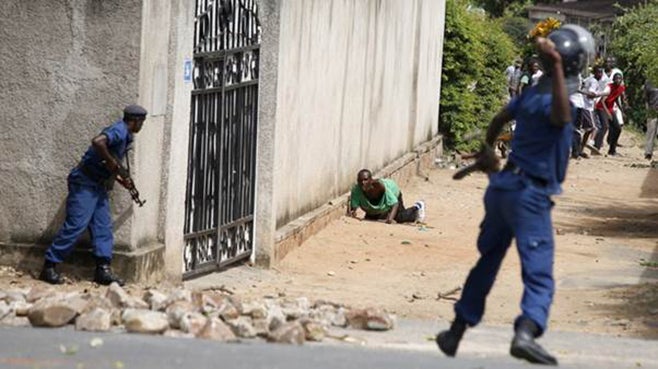

The Burundian authorities should call a halt to the crackdown on peaceful opponents and critics. They should order the police to stop using excessive deadly force, investigate the deaths and beatings of protesters at the hands of police, and hold those responsible for excessive force to account.
(Nairobi) – Burundian police have used excessive force in a crackdown on protests against President Pierre Nkurunziza’s election bid for a third term, Human Rights Watch said today.
Witness accounts indicate that police have shot and beaten people, in some cases when they posed no apparent threat. The authorities have closed down a number of radio stations and threatened journalists, human rights activists, and medical personnel.
“The Burundian authorities should call a halt to the crackdown on peaceful opponents and critics,” saidDaniel Bekele, Africa director at Human Rights Watch. “They should order the police to stop using excessive deadly force, investigate the deaths and beatings of protesters at the hands of police, and hold those responsible for excessive force to account.”
Restrictions on movements in the capital, and pervasive fear among the population, have made it difficult to confirm the exact number of victims. Based on interviews with medical personnel and other sources, Human Rights Watch believes that since demonstrations began on April 26, 2015, at least 27 people have been killed during the demonstrations or died from wounds inflicted during the demonstrations. Others have been killed in separate incidents. More than 300 people have been injured. It is likely that the overall number of dead is higher.
Thousands of protesters took to the streets after the murder on May 23 of Zedi Feruzi, president of the opposition party Union for Peace and Democracy-Zigamibanga (Union pour la paix et la démocratie-Zigabimanga). Human Rights Watch has not yet confirmed the circumstances of his death. A statement on the Burundian presidency’s website described it as “a despicable assassination” and promised an investigation.
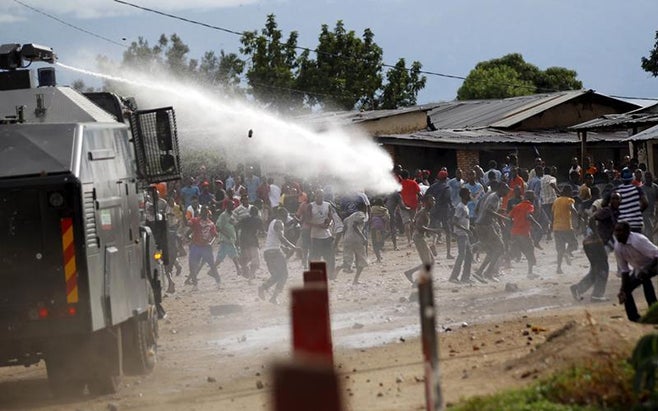
Police have responded aggressively to protests, with repeated clashes in several suburbs of the capital, Bujumbura. While many protesters have been peaceful, some have used violence. Witnesses say police have shot demonstrators indiscriminately – sometimes at point-blank range – in the head, neck, and chest. Medical personnel, witnesses, and a victim of a shooting told Human Rights Watch that some people were shot in the back as they fled. Medical staff in Bujumbura are treating more than 100 people with serious injuries.
Medical personnel, journalists, and human rights defenders have received death threats and menacing phone calls, and been intimidated and harassed by the authorities. Many of those who were threatened have gone into hiding or fled the country.
Public protests began in Bujumbura, on April 26. On May 13, a group of military officers attempted a coup and announced that Nkurunziza had been dismissed. Following heavy fighting between their supporters and members of the army loyal to Nkurunziza, the coup leaders announced on May 14 that their attempt had failed and they would surrender. Several officers allegedly involved in the coup attempt have been arrested. The whereabouts of their leader, Godefroid Niyombare, remain unknown.
Following the failed coup, demonstrators resumed their protests in Bujumbura on May 18, defying government orders to stop and warnings that demonstrators would be treated as supporters of the coup attempt.
In a May 18 statement, the External Relations and International Cooperation Ministry said that “the demonstrators will be treated as accomplices of the putschists as they are obstructing investigations into the putsch attempt and deliberately disturbing public order.” In contrast, a May 19 news release from the president’s office said that the government was not planning to take revenge, and that those involved in the coup attempt would be arrested and brought to justice according to the law.
Peaceful protesters and critics of the government should not be lumped together with those who attempted to overthrow the government, Human Rights Watch said.
Since demonstrations began, Burundian police have arrested hundreds of people, according to a Burundian police spokesperson and Burundian human rights organizations. They also beat detainees, witnesses and lawyers told Human Rights Watch. The Imbonerakure (“those who see far” in Kirundi) – members of the youth league of the ruling National Council for the Defense of Democracy-Forces for the Defense of Democracy (CNDD-FDD) – have also been implicated in beatings and threats.
Some of those killed or injured were taking part in protests while others were targeted in or near their homes. Human Rights Watch interviewed nine people with gunshot wounds who had been shot in various neighborhoods of Bujumbura, and obtained bullet casings from the Musaga neighborhood after police had shot at demonstrators there. A policeman confirmed to Human Rights Watch that some police had shot live ammunition and blank cartridges at protesters in Mutakura and Musaga neighborhoods during the first week of the demonstrations.
One man told Human Rights Watch that he was sitting near a road, away from protests, in the Cibitoke neighborhood on April 28 when four policemen approached him and told him to stand up. He stood up with his hands in the air. A policeman shot him at point blank range in the leg. He fell down, and the policeman said: “I got you.” The policeman picked up a stone as if to throw it at him. When other people arrived, the policemen fled. In another case, a victim said police shot him, then stomped on his head and body. He survived.
Some demonstrators have thrown stones and Molotov cocktails at the police, and used slingshots with stones, marbles, and other projectiles. Demonstrators have attacked people perceived to be Imbonerakure and policemen they accused of targeting demonstrators. Demonstrators who carry out violent attacks should be brought to justice, Human Rights Watch said.
The president’s main communications adviser, Willy Nyamitwe, told Human Rights Watch: “There are perhaps policemen who used too much force and others who were misguided. You need to recognize also that demonstrators are committing human rights abuses and they aren’t being reported.” He said some policemen had been arrested because “they used live ammunition against demonstrators” and added: “The president was clear: no act [of violence] will go unpunished. And that also goes for the demonstrators.”
The deputy police spokesman, Pierre Nkurikiye, said on May 25 that six police officers had been killed and at least 126 injured since the protests began. Nkurikiye said four policemen in Bujumbura were arrested for shooting at people. Three were provisionally released and one was still in custody. Investigations into all four cases are ongoing.
During demonstrations, the police should abide by the United Nations Principles on the Use of Force and Firearms by Law Enforcement Officials. The principles call upon law enforcement officials to apply nonviolent means before resorting to the use of force, to use force only in proportion to the seriousness of the offense, and to use lethal force only when strictly unavoidable to protect life.
Several hundred demonstrators and onlookers have been arrested since the protests began. Police figures indicate that 892 people were arrested in connection with the protests between April 26 and May 12. The deputy police spokesperson told Human Rights Watch in a meeting that police released 568 people, the majority of them minors or bystanders. The cases of 280 detainees had been transferred to the public prosecutor’s office. During the coup attempt, people ransacked the police detention center known as Bureau spécial de recherche (BSR) and released about 50 detainees.
The Burundian government should immediately restore respect for freedom of expression and assembly, including the freedom to demonstrate peacefully, allow radio stations to broadcast, and stop harassing journalists and human rights activists, Human Rights Watch said.
Governments and intergovernmental organizations, particularly the African Union, should pursue diplomatic efforts and impress upon the Burundian government the necessity to restore respect for fundamental human rights, as a precondition to peaceful and fair elections, Human Rights Watch said.
The UN Security Council should consider conducting a new mission to Burundi and make clear to all actors in Burundi that in the event of serious or widespread human rights violations, those responsible may face sanctions.
The UN and the African Commission on Human and Peoples’ Rights special rapporteurs covering freedom of expression and opinion; freedom of assembly and association; extrajudicial, summary or arbitrary executions; and the situation of human rights defenders should urgently visit Burundi and investigate recent abuses.
Human Rights Watch also encouraged the UN Office of the High Commissioner for Human Rights to increase its monitoring capacity in Burundi and keep the Human Rights Council informed of developments. The Office of the High Commissioner should document human rights violations through its country presence in Burundi and regularly and publicly report on its findings.
“Restraint is needed on all sides in Burundi,” Bekele said. “The police have the right to control crowds and may need to use force when confronted by violence, but they should do so only when strictly necessary and in a proportionate manner.”
For more detail and accounts by those interviewed, please see below.
Shootings by Police and Other Attacks
Based on interviews with a range of sources – including hospital staff, representatives of aid organizations, and human rights activists – Human Rights Watch believes that at least 27 people have been killed since the start of the demonstrations. Human Rights Watch has not been able to verify all deaths or confirm the exact total, which is likely to be higher.
Protesters Shot During Demonstrations
Human Rights Watch talked with nine people who had been shot during demonstrations. In many of the cases, it was unclear whether the police targeted specific demonstrators or shot indiscriminately, or whether the people were hit by stray bullets.
A 20-year-old student shot by police in the groin said he was demonstrating in Bujumbura’s Kinindo neighborhood on May 4 when policemen arrived and told demonstrators to move back:
Witness accounts indicate that police have shot and beaten people, in some cases when they posed no apparent threat. The authorities have closed down a number of radio stations and threatened journalists, human rights activists, and medical personnel.
“The Burundian authorities should call a halt to the crackdown on peaceful opponents and critics,” saidDaniel Bekele, Africa director at Human Rights Watch. “They should order the police to stop using excessive deadly force, investigate the deaths and beatings of protesters at the hands of police, and hold those responsible for excessive force to account.”
Restrictions on movements in the capital, and pervasive fear among the population, have made it difficult to confirm the exact number of victims. Based on interviews with medical personnel and other sources, Human Rights Watch believes that since demonstrations began on April 26, 2015, at least 27 people have been killed during the demonstrations or died from wounds inflicted during the demonstrations. Others have been killed in separate incidents. More than 300 people have been injured. It is likely that the overall number of dead is higher.
Thousands of protesters took to the streets after the murder on May 23 of Zedi Feruzi, president of the opposition party Union for Peace and Democracy-Zigamibanga (Union pour la paix et la démocratie-Zigabimanga). Human Rights Watch has not yet confirmed the circumstances of his death. A statement on the Burundian presidency’s website described it as “a despicable assassination” and promised an investigation.
Police have responded aggressively to protests, with repeated clashes in several suburbs of the capital, Bujumbura. While many protesters have been peaceful, some have used violence. Witnesses say police have shot demonstrators indiscriminately – sometimes at point-blank range – in the head, neck, and chest. Medical personnel, witnesses, and a victim of a shooting told Human Rights Watch that some people were shot in the back as they fled. Medical staff in Bujumbura are treating more than 100 people with serious injuries.
Medical personnel, journalists, and human rights defenders have received death threats and menacing phone calls, and been intimidated and harassed by the authorities. Many of those who were threatened have gone into hiding or fled the country.
Public protests began in Bujumbura, on April 26. On May 13, a group of military officers attempted a coup and announced that Nkurunziza had been dismissed. Following heavy fighting between their supporters and members of the army loyal to Nkurunziza, the coup leaders announced on May 14 that their attempt had failed and they would surrender. Several officers allegedly involved in the coup attempt have been arrested. The whereabouts of their leader, Godefroid Niyombare, remain unknown.
Following the failed coup, demonstrators resumed their protests in Bujumbura on May 18, defying government orders to stop and warnings that demonstrators would be treated as supporters of the coup attempt.
In a May 18 statement, the External Relations and International Cooperation Ministry said that “the demonstrators will be treated as accomplices of the putschists as they are obstructing investigations into the putsch attempt and deliberately disturbing public order.” In contrast, a May 19 news release from the president’s office said that the government was not planning to take revenge, and that those involved in the coup attempt would be arrested and brought to justice according to the law.
Peaceful protesters and critics of the government should not be lumped together with those who attempted to overthrow the government, Human Rights Watch said.
Since demonstrations began, Burundian police have arrested hundreds of people, according to a Burundian police spokesperson and Burundian human rights organizations. They also beat detainees, witnesses and lawyers told Human Rights Watch. The Imbonerakure (“those who see far” in Kirundi) – members of the youth league of the ruling National Council for the Defense of Democracy-Forces for the Defense of Democracy (CNDD-FDD) – have also been implicated in beatings and threats.
Some of those killed or injured were taking part in protests while others were targeted in or near their homes. Human Rights Watch interviewed nine people with gunshot wounds who had been shot in various neighborhoods of Bujumbura, and obtained bullet casings from the Musaga neighborhood after police had shot at demonstrators there. A policeman confirmed to Human Rights Watch that some police had shot live ammunition and blank cartridges at protesters in Mutakura and Musaga neighborhoods during the first week of the demonstrations.
One man told Human Rights Watch that he was sitting near a road, away from protests, in the Cibitoke neighborhood on April 28 when four policemen approached him and told him to stand up. He stood up with his hands in the air. A policeman shot him at point blank range in the leg. He fell down, and the policeman said: “I got you.” The policeman picked up a stone as if to throw it at him. When other people arrived, the policemen fled. In another case, a victim said police shot him, then stomped on his head and body. He survived.
Some demonstrators have thrown stones and Molotov cocktails at the police, and used slingshots with stones, marbles, and other projectiles. Demonstrators have attacked people perceived to be Imbonerakure and policemen they accused of targeting demonstrators. Demonstrators who carry out violent attacks should be brought to justice, Human Rights Watch said.
The president’s main communications adviser, Willy Nyamitwe, told Human Rights Watch: “There are perhaps policemen who used too much force and others who were misguided. You need to recognize also that demonstrators are committing human rights abuses and they aren’t being reported.” He said some policemen had been arrested because “they used live ammunition against demonstrators” and added: “The president was clear: no act [of violence] will go unpunished. And that also goes for the demonstrators.”
The deputy police spokesman, Pierre Nkurikiye, said on May 25 that six police officers had been killed and at least 126 injured since the protests began. Nkurikiye said four policemen in Bujumbura were arrested for shooting at people. Three were provisionally released and one was still in custody. Investigations into all four cases are ongoing.
During demonstrations, the police should abide by the United Nations Principles on the Use of Force and Firearms by Law Enforcement Officials. The principles call upon law enforcement officials to apply nonviolent means before resorting to the use of force, to use force only in proportion to the seriousness of the offense, and to use lethal force only when strictly unavoidable to protect life.
Several hundred demonstrators and onlookers have been arrested since the protests began. Police figures indicate that 892 people were arrested in connection with the protests between April 26 and May 12. The deputy police spokesperson told Human Rights Watch in a meeting that police released 568 people, the majority of them minors or bystanders. The cases of 280 detainees had been transferred to the public prosecutor’s office. During the coup attempt, people ransacked the police detention center known as Bureau spécial de recherche (BSR) and released about 50 detainees.
The Burundian government should immediately restore respect for freedom of expression and assembly, including the freedom to demonstrate peacefully, allow radio stations to broadcast, and stop harassing journalists and human rights activists, Human Rights Watch said.
Governments and intergovernmental organizations, particularly the African Union, should pursue diplomatic efforts and impress upon the Burundian government the necessity to restore respect for fundamental human rights, as a precondition to peaceful and fair elections, Human Rights Watch said.
The UN Security Council should consider conducting a new mission to Burundi and make clear to all actors in Burundi that in the event of serious or widespread human rights violations, those responsible may face sanctions.
The UN and the African Commission on Human and Peoples’ Rights special rapporteurs covering freedom of expression and opinion; freedom of assembly and association; extrajudicial, summary or arbitrary executions; and the situation of human rights defenders should urgently visit Burundi and investigate recent abuses.
Human Rights Watch also encouraged the UN Office of the High Commissioner for Human Rights to increase its monitoring capacity in Burundi and keep the Human Rights Council informed of developments. The Office of the High Commissioner should document human rights violations through its country presence in Burundi and regularly and publicly report on its findings.
“Restraint is needed on all sides in Burundi,” Bekele said. “The police have the right to control crowds and may need to use force when confronted by violence, but they should do so only when strictly necessary and in a proportionate manner.”
For more detail and accounts by those interviewed, please see below.
Shootings by Police and Other Attacks
Based on interviews with a range of sources – including hospital staff, representatives of aid organizations, and human rights activists – Human Rights Watch believes that at least 27 people have been killed since the start of the demonstrations. Human Rights Watch has not been able to verify all deaths or confirm the exact total, which is likely to be higher.
Protesters Shot During Demonstrations
Human Rights Watch talked with nine people who had been shot during demonstrations. In many of the cases, it was unclear whether the police targeted specific demonstrators or shot indiscriminately, or whether the people were hit by stray bullets.
A 20-year-old student shot by police in the groin said he was demonstrating in Bujumbura’s Kinindo neighborhood on May 4 when policemen arrived and told demonstrators to move back:
We told them we would stay in the road and demonstrate peacefully and we wouldn’t damage anything. Some police said they should let us demonstrate peacefully; others said they hadn’t received orders yet. They demanded that we leave the area before anything was damaged. We stayed there, dancing and singing. The police started removing rocks that were blocking the road. The demonstrators wouldn’t let them remove them. The police said: “If you refuse to let us remove them, you’ll see what will happen afterward.” The police threw four teargas grenades. Then they shot at us. They shot me as I was carrying my friend who had also been shot.
Another 20-year-old protester shot in the left knee said that policemen got out of a vehicle with tinted windows in Musaga on April 30 and started shooting:
I couldn’t escape. I was already hit. Four policemen came and started beating me. They kicked me and someone whipped me with a military belt. They said: “You are going to suffer because you are against the president of the republic.” They beat me for around three minutes. Then other protesters threw stones at them and they fled.
An 18-year-old student from Ngagara neighborhood said that on April 28, he accompanied a friend to his house in Cibitoke neighborhood. He said neither of them were participating in the demonstrations:
We were sitting on a cement block. That’s when we saw people running.… Afterward, we saw the police arrive where we were sitting. My friend fled. The police told me to stand up. I stood up with my hands in the air. Then he shot me in the leg. He said, “I got you.” He wanted to throw a stone at my head. A lot of people came up to us. Maybe that’s what stopped him.
A 30-year-old man said that on May 10, demonstrators in the Musaga neighborhood taunted police, and the police responded violently. One of the man’s friends was shot.
[The demonstrators] said: “We aren’t going to leave the street. We are against the third term [for the president].” There were around 30 police.… They started to shoot teargas. The demonstrators and people coming from church ran toward their houses. That’s when the police shot bullets. I can’t explain how it happened, because the bullets hit those in front of us. We weren’t hit.
I was just about to arrive at my house when I found [my friend]. He was weak and didn’t talk. They had shot him in his bottom and the bullet came out through his groin.
The man carried his friend, who was bleeding heavily, toward a first aid station. He said they came across a group of policemen, who told him, “Don’t bring your foolish things here,” referring to his injured friend. His friend died at a clinic before he could be treated.
A number of other attacks took place from April 26 on. The motives and the identity of the attackers were not always clear. For example, in Mutakura, men in camouflage uniforms and an unidentified man in civilian clothes visited several homes on the evening of April 26. They attacked residents with a machete, club, and bayonet and shot three of them dead. Some of the attackers shouted ethnic slurs as they were leaving.
Medical Personnel Threatened and Hospital Staff and Patients Endangered
Human Rights Watch spoke to medical personnel, injured demonstrators, and caregivers who said the police intimidated medical staff in several hospitals in Bujumbura. Witnesses said intelligence agents visited at least three hospitals, and in two demanded that hospital staff provide lists of demonstrators in their care. Government officials, accompanied by journalists, filmed patients in at least one hospital, without explanation. At least one hospital worker received phone calls from unidentified people threatening him with death for caring for demonstrators.
Witnesses said that on May 14, a group of 40 to 50 police officers loyal to Nkurunziza went to the private Bumerec hospital searching for wounded soldiers allegedly involved in the coup attempt who were being treated there. When the police tried to force their way into the emergency room, there was an exchange of gunfire between the police and the soldiers. The police shot into the emergency room from outside the door. A policeman was shot during an exchange of gunfire; it is not known whether he survived.
Soldiers loyal to the president arrived at the hospital to support the police. The police then went from room to room, searching for an injured female soldier. When they couldn’t find her, they forced all patients, staff, and caregivers into the courtyard. Some of the police threatened to “burn the hospital down” if they couldn’t find the soldier. The female soldier had changed into civilian clothes. When the police discovered her, a witness heard a policeman say: “Sorry. Normally, this shouldn’t happen. But during wartime, it happens like this.” The policemen left, taking with them the female soldier, one other injured soldier, and a third soldier who had been assisting them. The soldiers’ whereabouts are not known.
In a speech on May 20, Nkurunziza said judicial authorities should urgently investigate the “sad events” at the Bumerec hospital and ensure that those responsible are punished according to the law.
Beatings by Police
Police severely beat demonstrators and detainees in their custody, as well as in the custody of the intelligence services, victims and witnesses told Human Rights Watch.
Police arrested a 32-year-old man who was guarding his house on the night of April 29. He said that officers slapped him in the face and took him and at least one other man they had arrested to the commune (local government) office, where a policeman beat him and forced him to sign a statement:
A number of other attacks took place from April 26 on. The motives and the identity of the attackers were not always clear. For example, in Mutakura, men in camouflage uniforms and an unidentified man in civilian clothes visited several homes on the evening of April 26. They attacked residents with a machete, club, and bayonet and shot three of them dead. Some of the attackers shouted ethnic slurs as they were leaving.
Medical Personnel Threatened and Hospital Staff and Patients Endangered
Human Rights Watch spoke to medical personnel, injured demonstrators, and caregivers who said the police intimidated medical staff in several hospitals in Bujumbura. Witnesses said intelligence agents visited at least three hospitals, and in two demanded that hospital staff provide lists of demonstrators in their care. Government officials, accompanied by journalists, filmed patients in at least one hospital, without explanation. At least one hospital worker received phone calls from unidentified people threatening him with death for caring for demonstrators.
Witnesses said that on May 14, a group of 40 to 50 police officers loyal to Nkurunziza went to the private Bumerec hospital searching for wounded soldiers allegedly involved in the coup attempt who were being treated there. When the police tried to force their way into the emergency room, there was an exchange of gunfire between the police and the soldiers. The police shot into the emergency room from outside the door. A policeman was shot during an exchange of gunfire; it is not known whether he survived.
Soldiers loyal to the president arrived at the hospital to support the police. The police then went from room to room, searching for an injured female soldier. When they couldn’t find her, they forced all patients, staff, and caregivers into the courtyard. Some of the police threatened to “burn the hospital down” if they couldn’t find the soldier. The female soldier had changed into civilian clothes. When the police discovered her, a witness heard a policeman say: “Sorry. Normally, this shouldn’t happen. But during wartime, it happens like this.” The policemen left, taking with them the female soldier, one other injured soldier, and a third soldier who had been assisting them. The soldiers’ whereabouts are not known.
In a speech on May 20, Nkurunziza said judicial authorities should urgently investigate the “sad events” at the Bumerec hospital and ensure that those responsible are punished according to the law.
Beatings by Police
Police severely beat demonstrators and detainees in their custody, as well as in the custody of the intelligence services, victims and witnesses told Human Rights Watch.
Police arrested a 32-year-old man who was guarding his house on the night of April 29. He said that officers slapped him in the face and took him and at least one other man they had arrested to the commune (local government) office, where a policeman beat him and forced him to sign a statement:
He [the police officer] was furious. The first thing he did, he looked for some paper on which to write my statement. Then he started to hit us. He used an electrical cable. He said: “You have weapons, and you are protesting against the third term of the president.” I said: “We don’t have weapons.” He beat us so we would accept everything he wrote down and all his questions. When we tried to say that his accusation against us – having weapons – wasn’t true, he beat us again so we would admit it.
Afterward, he put me on a chair, put my arms behind my back and beat me all over. When he tried to make me sign [the statement] by force, [a policeman] found a machete. He hit me with it on the back with the flat side. It was [another] policeman who hit me with it. [The policeman] took an ink pad. He forcibly took my hand and he put it in the ink pad and then put it on the paper.
The man was taken to the BSR – the police detention center – then, along with other detainees, to the intelligence services. He said an intelligence official registered him, then he heard the official give an order to take the detainees to “school” (presumably meaning take them to be beaten). The man said that police assigned to the intelligence services beat the detainees with an iron bar used in building construction:
We were beaten with an iron bar on the bottom. The SNR [intelligence services] gave orders to the police to beat us. We were at least seven in the corridor [being beaten]. They said: “You are at school and you will return intelligent.” Each person had a policeman who beat him. When one got tired, another would come. After they finished, they slapped us on the ears. Even now, I have a problem hearing out of my left ear. I saw others who were beaten after us. The others came in [to our cell] in a bad state and had to be taken to the hospital.
A 26-year-old female demonstrator said that four policemen beat her after she was arrested with eight other demonstrators on May 4 near the university. Police drove them to a wooded area near a police camp where they beat them again:
They hit us hard with police truncheons. More than 10 policemen were there and participated. We were also beaten by the one who brought us. One took his truncheon and the others took theirs and they beat everyone. Each of them took one of us. When we were lying on the ground, they hit us on the back and often on the soles of our feet. They beat us for five minutes. I screamed: “Forgive us!” I said: “Jesus! Jesus!” when they were hitting me. They said: “Don’t call Jesus. He’s not the one who asked you to go to the demonstration.”
A 38-year-old human rights activist was arrested on May 4 in Bujumbura’s Cibitoke neighborhood. He said that during the demonstration, he had picked up a child as police started shooting. As he was carrying the child to safety, about 10 policemen attacked him. They beat him with truncheons and belts and kicked him. They let him put the child down and told him to get into a truck with tinted windows and said they were taking him to Camp Socarti, a police camp in Bujumbura:
I said: “No, I’m not a policeman.” They said: “You don’t have any rights.” I said: “I’m not a policeman or a soldier. I’ll open the door and jump out while the car is moving.” [The policeman] told me to get down and lie down in the middle of the road. They started beating me. While they were beating me, Radio Bonesha [a private radio station] was playing and they heard the radio mention my name. [One of the policemen] said: “You, who are you, you imbecile?” I said: “I’m a simple citizen. Everything you are doing is being brought up on the radio.”
The police drove him to the Kamenge neighborhood, where he gave a statement to the judicial police:
On Monday night, a person claiming he was the head of the criminal research section of the judicial police … told me to come with him. He brought a [handwritten] sign that was against the president’s third term. He wanted to take a picture of me with the sign. I said: “I can’t be photographed in front of this sign. I’m not the person who wrote it and you didn’t catch me with it.” I said this in front of the [judicial police officer]. He supported me.
The activist was taken to the BSR, then released.
Lawyers who visited detainees in the BSR told Human Rights Watch that detainees held there before the coup attempt were kept in very poor conditions. Some arrived at the BSR lying face down in police vehicles, with police holding the detainees down with their feet, the lawyers said, while others were beaten when they were arrested.
Abuses and Threats by Imbonerakure
Since Burundi’s last elections in 2010, the ruling CNDD-FDD has used the Imbonerakure to threatenopposition party members and force them to switch their allegiance, often through violent means. FewImbonerakure have been brought to justice for these crimes.
Since the protests began on April 26, 2015, Imbonerakure have ill-treated and threatened suspected opponents of the CNDD-FDD. A 32-year-old Imbonerakure living in Bujumbura told Human Rights Watch on May 2: “We put down what we don’t agree with. We intimidate people. We tell them: If you aren’t part of our party, you won’t work anywhere in Burundi. Those who try to fight us, we can kill them.”
On April 30, a human rights activist saw about 30 Imbonerakure walking single file near the parish in Kanyosha, toward one of the areas of the demonstrations. Some were holding bicycle chains or machetes, the activist said.
An Imbonerakure living in Bujumbura said that Imbonerakure from Ngozi and Bubanza provinces had come to the capital to intimidate protesters and reinforce Imbonerakure and police there. He said that Imbonerakurewho succeeded in thwarting the demonstrators were promised up to 10,000 Burundian francs (US$5.71) for a day’s work:
Lawyers who visited detainees in the BSR told Human Rights Watch that detainees held there before the coup attempt were kept in very poor conditions. Some arrived at the BSR lying face down in police vehicles, with police holding the detainees down with their feet, the lawyers said, while others were beaten when they were arrested.
Abuses and Threats by Imbonerakure
Since Burundi’s last elections in 2010, the ruling CNDD-FDD has used the Imbonerakure to threatenopposition party members and force them to switch their allegiance, often through violent means. FewImbonerakure have been brought to justice for these crimes.
Since the protests began on April 26, 2015, Imbonerakure have ill-treated and threatened suspected opponents of the CNDD-FDD. A 32-year-old Imbonerakure living in Bujumbura told Human Rights Watch on May 2: “We put down what we don’t agree with. We intimidate people. We tell them: If you aren’t part of our party, you won’t work anywhere in Burundi. Those who try to fight us, we can kill them.”
On April 30, a human rights activist saw about 30 Imbonerakure walking single file near the parish in Kanyosha, toward one of the areas of the demonstrations. Some were holding bicycle chains or machetes, the activist said.
An Imbonerakure living in Bujumbura said that Imbonerakure from Ngozi and Bubanza provinces had come to the capital to intimidate protesters and reinforce Imbonerakure and police there. He said that Imbonerakurewho succeeded in thwarting the demonstrators were promised up to 10,000 Burundian francs (US$5.71) for a day’s work:
The machetes, we don’t hide them. They are there to intimidate people. We don’t go up to the police. They see us and they let us do what we want. They are informed about what we should do.
Where I live, we have three guns in our group, Kalashnikovs. Our boss gave them to us. We’ve had [the guns] for a long time, since before the 2010 elections. Each group of Imbonerakure has some guns, even grenades and bullets.We cannot go out without machetes, grenades, or clubs. We wear things we can hide this stuff in. We have sticks studded with nails. We yell at the demonstrators: “Those who want to die, come close!” [When we are at the demonstrations] nobody tells us what to do. We go there to stop the demonstrators so they don’t come to our zone and influence others.
Human Rights Watch interviewed a 26-year-old teacher and member of the opposition party FRODEBU-Nyakuri, who had fled to Rwanda in late March 2015. He said Imbonerakure had come to his school twice, on March 14 and March 21, and told him to renounce his party or lose his job:
On the evening of March 24, a friend warned me the Imbonerakure were looking for me at my house. They were armed with clubs, sticks, machetes, and iron bars. I called my neighbor to come help me. I left dressed in my pajamas and a T-shirt with the photo of Pierre Nkurunziza. Immediately [two of the Imbonerakure] made me lie on the ground and started to hit me.
He said his neighbors called the police. The three Imbonerakure were arrested in connection with the beating but released the next day.
Curbs on Media Freedom, Threats Against Journalists and Human Rights Defenders
The government has targeted the media in its crackdown since protests began.
One of the government’s first measures was to close down one of the country’s most popular radio stations, Radio publique africaine (RPA), on April 27. Senior government officials and police entered the station’s offices, and ordered the journalists to leave and the radio station to close. On the same day, the government stopped Radio Isanganiro and Radio Bonesha FM from broadcasting outside the capital, cut off their telephone land lines, and prohibited all three stations from broadcasting live from the demonstrations.
In the following days, the Communications Minister Tharcisse Nkezabahizi called the director of Radio Isanganiro to his office several times to complain about the station’s broadcasts, choice of music, and treatment and choice of stories.
Soon after the coup attempt, during the early hours of May 14, people presumed loyal to the president attackedthe offices of RPA, Radio Bonesha, Radio Isanganiro, and Radio-Télévision Renaissance. None of these stations have broadcast since. There were also reports that unidentified people attacked the offices of Radio Rema FM, a station close to the ruling party, on May 13; it too has remained off the air.
The attack at Radio Bonesha was particularly violent, said journalists at the radio station and another witness. Men in police uniforms threw a grenade in the office and shot at the radio’s broadcasting equipment, destroying it. A man who happened to be in the vicinity witnessed the attack:
Curbs on Media Freedom, Threats Against Journalists and Human Rights Defenders
The government has targeted the media in its crackdown since protests began.
One of the government’s first measures was to close down one of the country’s most popular radio stations, Radio publique africaine (RPA), on April 27. Senior government officials and police entered the station’s offices, and ordered the journalists to leave and the radio station to close. On the same day, the government stopped Radio Isanganiro and Radio Bonesha FM from broadcasting outside the capital, cut off their telephone land lines, and prohibited all three stations from broadcasting live from the demonstrations.
In the following days, the Communications Minister Tharcisse Nkezabahizi called the director of Radio Isanganiro to his office several times to complain about the station’s broadcasts, choice of music, and treatment and choice of stories.
Soon after the coup attempt, during the early hours of May 14, people presumed loyal to the president attackedthe offices of RPA, Radio Bonesha, Radio Isanganiro, and Radio-Télévision Renaissance. None of these stations have broadcast since. There were also reports that unidentified people attacked the offices of Radio Rema FM, a station close to the ruling party, on May 13; it too has remained off the air.
The attack at Radio Bonesha was particularly violent, said journalists at the radio station and another witness. Men in police uniforms threw a grenade in the office and shot at the radio’s broadcasting equipment, destroying it. A man who happened to be in the vicinity witnessed the attack:
I saw a truck with police in it.… They started shooting at Bonesha. There were soldiers inside Bonesha, left by the putschists, I imagine. When the police heard the soldiers fire back, they said: “There are military inside.” They got back in the truck and drove off.
Then I saw a lot of police coming back, with heavy weapons. They took up positions in different places.… They forced open Bonesha’s gate and shot a lot. Many, many of them entered. I hid behind a building under construction.… I have never seen police with heavy weapons like this before. I saw them carrying rocket launchers over their shoulders. They were wearing new uniforms. After they entered the building and went upstairs, there was an explosion.
In a message to the nation on May 20, Nkurunziza warned “Burundian or foreign media who might try to broadcast information that could disseminate hate and division among Burundians and discredit Burundi, or encourage insurrection movements during this electoral period.”
In a five-page written statement on May 22, the government Secretary-General and Spokesperson Philippe Nzobonariba stated that radio stations had become “agents that convey the insurrection by propagating the most alarmist rumors in the country.”
Police have assaulted and threatened individual journalists. On April 29, two policemen accosted a Burundian press photographer who was taking pictures at the scene of a demonstration. The policeman grabbed the journalist’s camera and erased all of the photos. The policeman told the journalist that he couldn’t take pictures wherever he wanted and told the second policeman to force the photojournalist to leave: “He hit me four times on the left elbow. I asked him: ‘Why are you beating me like a criminal?’ He said: ‘I can even kill you.’”
On May 2, the same photojournalist received a telephone call from an unknown number. The caller did not identify himself. He said: “You see? It’s difficult to take pictures where you want to. You aren’t going to take photos. If you continue taking photos, you can even die.”
On May 4, a Burundian journalist and two colleagues were covering the demonstrations when several policemen approached his car, arrested the journalist, and accused his colleagues of having weapons. The journalist said the policeman claimed to have an SMS message ordering his arrest. Police released him later that night.
The following day, two men in civilian clothes, who did not identify themselves, arrived at the journalist’s house and told him to come with them to the police station. They questioned him and told him there was a list of journalists who work for the opposition and are financed by white people. When the journalist asked for further information, they said: “When you ask a lot of things, you will have a lot of things happen to you.”
The next day, two men in civilian clothes who said they worked for the government questioned a fellow journalist and told him: “You are on a blacklist like other journalists who work with white people.” It is unclear whether they were the same men.
Burundian human rights activists and other members of nongovernmental organizations have also been repeatedly threatened since April 26, especially those who have campaigned against Nkurunziza’s third term. A leading human rights defender, Pierre Claver Mbonimpa, president of the human rights group APRODH, was arrested on April 27 and released the following day. Many activists and journalists have gone into hiding for fear of arrest or reprisals by government agents.
Violence by Demonstrators
Some demonstrators have resorted to violence and intimidation, despite public appeals by leaders of nongovernmental organizations to keep the protests peaceful. In some areas, protesters have prevented residents from leaving their neighborhoods, turning them back at roadblocks and telling them to join or support the protests. Demonstrators have burned vehicles, attacked and ransacked buildings, and injured police by throwing stones. Demonstrators should refrain from acts of violence, Human Rights Watch said.
Demonstrators killed a suspected Imbonerakure in the Nyakabiga III neighborhood on May 7. A witness told Human Rights Watch that market women informed demonstrators that a vehicle had dropped off three unknown men in the area that morning. Demonstrators caught two of the men. One of the two said he was from the neighborhood but nobody recognized him. Demonstrators believed he was an Imbonerakure, surrounded him, and wanted to stone him to death. Some demonstrators didn’t agree and an argument broke out.
A witness at the scene said some demonstrators shouted: “We are being killed all the time. Since we are killed without scruples, we should kill him also.” Others said: “Kill him. [The Imbonerakure] throw grenades and they aren’t punished. We should punish them.”
Demonstrators surrounded the Imbonerakure, threw stones at his head, and hit him with clubs. After he died, they put a tire around his body and burned him. The killing should be investigated and those responsible brought to justice, Human Rights Watch said.
On May 7, demonstrators prevented students in Nyakabiga from attending school exams and refused to let them through roadblocks. They told parents there would be no national exams and that they should not take their children to school.
A teacher at a school where exams were due to take place said demonstrators yelled: “Don’t let the exams take place! They [the students] have to leave! If not, we’ll make them leave.” About 70 demonstrators threw stones at the school building. After talking with demonstrators, school staff agreed not to hold the exams.
In a five-page written statement on May 22, the government Secretary-General and Spokesperson Philippe Nzobonariba stated that radio stations had become “agents that convey the insurrection by propagating the most alarmist rumors in the country.”
Police have assaulted and threatened individual journalists. On April 29, two policemen accosted a Burundian press photographer who was taking pictures at the scene of a demonstration. The policeman grabbed the journalist’s camera and erased all of the photos. The policeman told the journalist that he couldn’t take pictures wherever he wanted and told the second policeman to force the photojournalist to leave: “He hit me four times on the left elbow. I asked him: ‘Why are you beating me like a criminal?’ He said: ‘I can even kill you.’”
On May 2, the same photojournalist received a telephone call from an unknown number. The caller did not identify himself. He said: “You see? It’s difficult to take pictures where you want to. You aren’t going to take photos. If you continue taking photos, you can even die.”
On May 4, a Burundian journalist and two colleagues were covering the demonstrations when several policemen approached his car, arrested the journalist, and accused his colleagues of having weapons. The journalist said the policeman claimed to have an SMS message ordering his arrest. Police released him later that night.
The following day, two men in civilian clothes, who did not identify themselves, arrived at the journalist’s house and told him to come with them to the police station. They questioned him and told him there was a list of journalists who work for the opposition and are financed by white people. When the journalist asked for further information, they said: “When you ask a lot of things, you will have a lot of things happen to you.”
The next day, two men in civilian clothes who said they worked for the government questioned a fellow journalist and told him: “You are on a blacklist like other journalists who work with white people.” It is unclear whether they were the same men.
Burundian human rights activists and other members of nongovernmental organizations have also been repeatedly threatened since April 26, especially those who have campaigned against Nkurunziza’s third term. A leading human rights defender, Pierre Claver Mbonimpa, president of the human rights group APRODH, was arrested on April 27 and released the following day. Many activists and journalists have gone into hiding for fear of arrest or reprisals by government agents.
Violence by Demonstrators
Some demonstrators have resorted to violence and intimidation, despite public appeals by leaders of nongovernmental organizations to keep the protests peaceful. In some areas, protesters have prevented residents from leaving their neighborhoods, turning them back at roadblocks and telling them to join or support the protests. Demonstrators have burned vehicles, attacked and ransacked buildings, and injured police by throwing stones. Demonstrators should refrain from acts of violence, Human Rights Watch said.
Demonstrators killed a suspected Imbonerakure in the Nyakabiga III neighborhood on May 7. A witness told Human Rights Watch that market women informed demonstrators that a vehicle had dropped off three unknown men in the area that morning. Demonstrators caught two of the men. One of the two said he was from the neighborhood but nobody recognized him. Demonstrators believed he was an Imbonerakure, surrounded him, and wanted to stone him to death. Some demonstrators didn’t agree and an argument broke out.
A witness at the scene said some demonstrators shouted: “We are being killed all the time. Since we are killed without scruples, we should kill him also.” Others said: “Kill him. [The Imbonerakure] throw grenades and they aren’t punished. We should punish them.”
Demonstrators surrounded the Imbonerakure, threw stones at his head, and hit him with clubs. After he died, they put a tire around his body and burned him. The killing should be investigated and those responsible brought to justice, Human Rights Watch said.
On May 7, demonstrators prevented students in Nyakabiga from attending school exams and refused to let them through roadblocks. They told parents there would be no national exams and that they should not take their children to school.
A teacher at a school where exams were due to take place said demonstrators yelled: “Don’t let the exams take place! They [the students] have to leave! If not, we’ll make them leave.” About 70 demonstrators threw stones at the school building. After talking with demonstrators, school staff agreed not to hold the exams.


