Saturday, 26 September 2009

By JOHN HEILPRIN
Associated Press Writer
UNITED NATIONS -- Inside the General Assembly's cavernous chamber, as leaders began filling nearly every seat and aisles were standing-room only, the light-colored robes of some African and Mideast leaders dotted a sea of dark business suits. Polite applause followed the opening remarks of U.N. Secretary-General Ban Ki-moon and General Assembly President Ali Treki.
Libyan leader Moammar Gadhafi, in his first U.N. appearance, arrived just in time for Wednesday's leadoff speech by Brazil's President Luiz Inacio Lula da Silva. Gadhafi sat in a seventh-row aisle seat, off the left side.
Dressed in flowing brown and tan Bedouin robes, and a black beret that he self-consciously patted at times, he listened through a translation earpiece in his right ear and fiddled with the cord in his left hand. Occasionally he looked around the room.
Aides huddled around him; he kept his glasses, a red handkerchief and a rumpled yellow folder in front of him on the desk. Then he removed his earpiece to jot a note to himself and put it into the yellow folder. He joined the applause at one point. Then he flipped through the handwritten pages of flowing rows of bold Arabic characters inside the folders.
---
A commotion swept the room as President Barack Obama appeared. Everyone tried to see him. Gadhafi joined in the light applause that greeted Obama, then listened raptly with the earpiece held to his left ear.
From his fifth-row aisle seat near the chamber's center, Iranian President Mahmoud Ahmadinejad also listened to Obama, but without an earpiece. The Iranian leader seemed relaxed. He was tieless. Ahmadinejad kept regularly checking the watch on his left wrist while peering at Obama. Next to him, Foreign Minister Manouchehr Mottaki and Iran's U.N. Ambassador Mohammad Khazee each listened with earpieces.
As Obama gestured and read from the TelePrompTer, speaking of the dangers of nuclear proliferation, the Iranians listened intently. Ahmadinejad leaned to his right and said something to Mottaki.
Ahmadinejad and Gadhafi both refrained from joining applause for Obama's comments on Sudan, the Middle East and other U.S. pledges for peace and world security. But Gadhafi joined in clapping when Obama ended his speech. Ahmadinejad didn't. Obama didn't get a standing ovation, but he got warm applause. Many of the delegates in the room abruptly left moments after Obama spoke.
That included the entire U.S. delegation of prominent figures including White House Chief of Staff Rahm Emanuel, Secretary of State Hillary Rodham Clinton, U.N. Ambassador Susan Rice, National Security Adviser Gen. Jim Jones, Obama adviser Samantha Power and Assistant Secretary for International Organization Affairs Esther Brimmer. Lower-level U.S. delegation staff remained.
It wasn't clear if this was a protest or if they were merely following Obama from the room.
After Gadhafi was introduced as the "king of kings" by his fellow Libyan, Treki, he remained in his seat for at least five minutes. Gadhafi was supposed to be in a holding area off the stage. He took no notice of protocol.
Gadhafi was surrounded by aides and confusion seemed to take over. Half the seats emptied as delegates wandered the aisles without any direction from Treki or Ban.
Gadhafi kept shaking hands as delegates left. Treki finally tried to gavel the place to order. Gadhafi paid no attention, putting the red handkerchief to his mouth. He leaned back in his chair, seeming to have not a care in the world, and received advice from aides. He smiled broadly, enjoying the moment - the world waiting to hear from him.

Finally, Gadhafi rose, swept his robes over him and strode to the stage. He needed the handrail on his way up. He laid the shabby yellow folder on the podium, and pulled out some of the handwritten pages. There was scattered applause.
By then the chamber was half-empty. Gadhafi, in his first speech to the U.N., held up a copy of the U.N. Charter. He wore big, shiny rings on each hand. For a moment, it seemed as if he were lost in thought. He stopped and sorted through the pages of his yellow folder.
It seemed he was winging the speech. Evidently, he had jotted a set of ideas in bold letters which he had before him on the handwritten pages. But there was no prepared text. He was not reading from the TelePrompTer.
As he gestured, a black pin in the shape of Africa, with a white outline, reflected light from his right chest where it was attached to his robe. He began railing against the U.N. power structure, which is tilted toward the five permanent members of the Security Council. He called the General Assembly "the parliament of the world" - a body that should be dictating decisions to the Security Council.
"How can we be happy about the world security if the world is controlled by four or five powers?" he complained. "We are just like a decor." After several minutes of rambling remarks, that last comment won him scattered applause.
At one point he called the General Assembly "the master of the world ... this is democracy and then we put an end to the Security Council ... this is terrorism in itself."
He slightly ripped the U.N. Charter book when he was done with it.
Delegates began walking out at that point. People's faces registered amazement and disbelief. Others laughed or smiled, perhaps in embarrassment or not knowing how to respond. Many spoke among themselves. By now at least half the assembly - that he called the supreme leader of the world - was deserting Gadhafi.
And he was simply emptying his mind, without the least self-consciousness, before a gathering of world leaders.
In place of the sea of business suits were dozens of empty blue and beige seats. People kept wandering out as Gadhafi spoke of "feudalism."
"It should not be called the Security Council, it should be called the Terror Council," he said.
At that, another wave of delegates dashed out. Gadhafi failed to note that his nation now held a Security Council seat. "Terror and sanctions - it is used against us only," he said.
And with Treki chairing the assembly, there was no stopping Gadhafi, also the head of the African Union, as he railed against what the U.N. has or hasn't done about 65 wars he said have erupted around the world since the organization was founded in 1945.
Gadhafi then demanded a permanent AU seat on the Security Council. Even Ahmadinejad had left by now.
---
Safe to say that toward the end of his speech, more than half the seats were empty.
"Obama is a glimpse in the dark for the next four or eight years, and I'm afraid we may go back to square one" after he steps down," Gadhafi said. When he suggested Obama stay on as leader indefinitely, there was scattered applause.
He kept holding up the handwritten pages in front of him, at one point reading from it in his diatribe against the U.N. power structure. He also railed against former President George W. Bush's policy of trying to build democracy in Iraq.
Then Gadhafi got more personal. "It is clear that all of you are lacking the energy because of traveling a long way," he said, adding he had woken up at 4 a.m. in New York. It was tantalizingly unclear where he was going with this.


We should thank America, and we thank America. ... We want to make America secure," he said, talking about whether the U.N. is a terrorist target, and invoking worries of another 9/11. "We want to relieve America from this worry."
But now it seemed Gadhafi was perhaps suggesting that the U.N. and the General Assembly should be relocated to Tripoli, the Libyan capital where he has tried to locate AU headquarters.
"We don't have to come to New York and be subjected to all these measures," he said, referring to the heavy security around the U.N. and issues getting U.S. visas.
He seemed to be referring, but did not directly mention, his struggle to pitch a Bedouin tent, as is his practice when he travels, in the New York area. There also was no mention of his ill will toward Switzerland because of his son's arrest there.
"You will thank me for not having to travel for 20 hours to this place," he added. "America will thank you for alleviating the hardship of America. ... This place is targeted by terrorists."
His litany of injustices then extended to "3 million victims of the Vietnam War" and the U.S. actions in Panama, Grenada and Somalia, among other places and conflicts.
"How this can be done with impunity?" he asked. "Can we trust the Security Council?"
Gadhafi then demanded more investigation into the deaths of Dag Hammarskjold, John F. Kennedy, Martin Luther King and others that he saw as unsolved murders and conspiracies.
"These are crimes. We cannot keep quiet. We cannot keep silent," he intoned, shaking and peering down at the handwritten pages. He also attempted a defense of Somali pirates as ex-fishermen protecting their wealth, and said he had spoken to the pirates.
Gadhafi also made a pitch for his own Web site, with speeches on it for people to read. Someone handed him a piece of paper, perhaps to get him to stop speaking. He crumpled it up.
He had worn out even the translators - a woman's voice replaced the man who had been speaking. He paid no attention to the red light to the right of the lectern, which had long ago told him the speech should be at an end.
Gadhafi seemed to be making up for all his 40 years of missed appearances at the United Nations.
And when he finally ended, after 1 hour and 36 minutes of stream-of-consciousness on the world's stage, delegates lightly applauded, and no one stood. But Gadhafi clasped his hands above him and waved in triumph as he left.
President Kikwete in High-Level Meeting
on Better Health Services for Women

and Children ...Secretary-General Ban Ki-moon(centre)attends a high-level meeting on the theme,Investing in Our Common Future:Healthy Women,Healthy Children,chaired by Gordon Brown(second from right),Prime Minister of the United Kingdom and Northern Ireland,and Robert Zoellick (second from left),President of the World Bank.The event was hosted by the Taskforce on Innovative International Financing for Health Systems,also co-chaired by the Prime Minister and Bank President.Also at the meeting was Jakaya Mrisho Kikwete (left),President of the United Republic of Tanzania.Photo Mark Garten


If fate had taken a different turn, Heather Frederiksen might well have won an Olympic gold medal for Britain in Beijing along with her friend, Rebecca Adlington, and had dreams about her own pair of Jimmy Choos.

Moving moment:
Heather Frederiksen's gold is an extraordinary achievement - Moving moment: Heather Frederiksen's gold is an extraordinary achievement
Instead, Frederiksen’s gold medal came at the Paralympics, and it was not expensive footwear that was on her mind – it was the memory of the hospital consultant who told her that she would never be able to swim again. “I’ve proved some people wrong,” she said.


Prior to her accident, Heather had won both the British 10km Open Water Championship and 4.5 km British Grand Prix on the same day. One year on from the accident Heather teamed up again with coach John Stout of the City of Salford Club, and now competes in the S8 (backstroke and freestyle), SB7 (breaststroke) and SM8 (medley) classifications. Her first senior swim meet came at the 2007 German Open, in Berlin.


PHOTOS:Ayoub mzee
Seen here present at the London Olyimpcs open day


The olyipic park model on display


One miute ist been raining in London then shine shine.Such a weather


Ayoub mzee with one of the Britain olympic champions


Friday, 25 September 2009


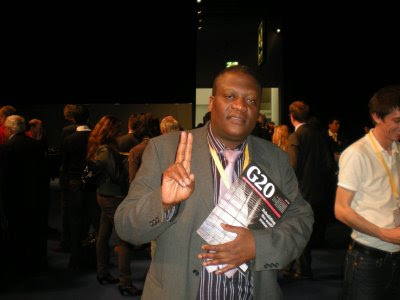
The G20 Pittsburgh Summit 2009
Edited by John Kirton and Madeline KochPublished by Newsdesk Media Group and the G20 Research Group, 2009
To order a printed copy, please click here.
To download a low-resolution pdf, click here. (Be patient! It's 7.7 MB.)
The President’s Welcome Message for the Pittsburgh SummitBarack Obama, president, United States of America [English] [Français] [Deutsch] [Russian] [Portuguesa] [Chinese] [Korean] [Japanese]
London’s legacyGordon Brown, prime minister, United Kingdom [English] [French] [Chinese]

Pittsburgh: bridging the Washington-London G20 summits and beyondLee Myung-bak, president, Republic of Korea [English] [Korean] [Chinese]

Brazil’s approach to shared growth and global governanceLuiz Inácio Lula da Silva, president, Brazil [English] [Chinese]

From Pittsburgh to Muskoka: building a sustainable global recovery Stephen Harper, prime minister, Canada [English] [Français] [Russian] [Chinese] [Korean]

Prospects for the Pittsburgh Summit John Kirton, director, G20 Research Group, and Jenilee Guebert, research coordinator, G20 Research Group [English] [Français] [Chinese]
The world economy: road to recovery Jim O’Neill, Goldman Sachs [English]
Welcome to PittsburghDan Onorato, Allegheny County Executive, and Luke Ravenstahl, mayor, City of Pittsburgh
[English]

The pathway to economic recovery
A strategy for global economic growth Angel Gurría, secretary general, Organisation for Economic Co-operation and Development
[English]

America’s contribution to global economic growth Robert Fauver, former US under secretary of state for economic affairs and former G7 sherpa [English]

China: a revisionist rather than a revolutionist Tu Xinquan, associate director, China Institute for World Trade Organization Studies, University of International Business and Economics [English] [Chinese]

Reforming financial regulation & supervision
Regulating the banks: next stepsPaolo Savona, professor emeritus, geopolitical economy, and economic adviser, Associazione Guido Carli
Pay, risk and stewardship for future capital markets Stephen Davis, Millstein Center for Corporate Governance and Performance, Yale University
Rating credit responsibly Anthony Hilton, financial editor, London Evening Standard
Dealing with derivatives Chiara Oldani, professor of economics, University of Viterbo ‘La Tuscia’; director of research, Assonebb
The challenges and contributions of offshore jurisdictions Denisse Rudich, Serum International
Islamic finance: an alternative financial model Ahmad Mohamed Ali, president, Islamic Development Bank
[English]
Government perspective
Adopting the G20 agenda in the EU Mats Odell, Sweden’s minister for local government and financial markets
Reconstructing global financial institutions
The Financial Stability Board: international cooperation to promote financial stability Mario Draghi, chair, Financial Stability Board
[English]
A new International Monetary Fund? Domenico Lombardi, president, Oxford Institute for Economic Policy, and non-resident senior fellow, Brookings Institution
[English]
Bretton Woods 1944 versus Pittsburgh 2009 Naoki Tanaka, president, Centre for International Public Policy Studies
[English] [Japanese]
Restoring trade, investment, infrastructure
The International Finance Corporation’s role in trade finance and development Lars H. Thunell, executive vice president and CEO, International Finance Corporation
[English]
The trouble with trade: the Pittsburgh G20 leaders’ review Alan S. Alexandroff, Program on Conflict Management and Negotiation, University of Toronto and The Centre for International Governance Innovation, and Andrew F. Cooper, The Centre for International Governance Innovation
[English]
India’s role in getting Doha done Yoginder K. Alagh, chancellor, Central University of Nagaland, and former minister, power, planning and science and technology, India
Green investment for climate & energy security
The Copenhagen conference’s climate change challenge Lars Lokke Rasmussen, prime minister, Denmark
[English] [Chinese]

The sustainable energy contribution Nobuo Tanaka, executive director, International Energy Agency [English]


How Pittsburgh can help Copenhagen on climate change Frank Loy, former US under secretary of state for global affairs and former chief climate negotiator

From conventional to creative energy supply strategies Victoria V. Panova, Moscow State Institute of International Relations
Deploying carbon capture and storage Nick Otter, CEO, Global CCS Institute
Financing renewable energy technologies and production Raili Kajaste, Nordic Environment Finance Corporation, and Risto Penttilä, Finnish Business and Policy Forum EVA
Reinforcing development, food security & health
The G20, or the G200? A Commonwealth view on global development challengesKamalesh Sharma, Commonwealth secretary general [English]
Achieving interdependence Haruhiko Kuroda, president, Asian Development Bank [English] [Russian] [Korean] [Japanese] [Chinese](Translations provided by the Asian Development Bank)
Growing to meet future challenges Luis Alberto Moreno, president, Inter-American Development Bank [English]
Long-term commitment vital for Africa’s growth Donald Kaberuka, president, African Development Bank [English]
Securing food and agriculture worldwide Donald G.M. Coxe, chair, Coxe Advisors LLC [English]

Food security and the biofuels challenge C. Ford Runge, Distinguished McKnight University Professor of Applied Economics and Law, University of Minnesota
America’s global health support for development Gloria Steele, head, Global Health, USAID
Health security from economic and environmental innovation Jeffrey L. Sturchio, president and CEO, Global Health Council
Actors & stakeholders

This Information System is provided by the University of Toronto Libraryand the G20 Research Group and G8 Research Group at the University of Toronto


President Museveni address the UN general assembly yesterday
UNITED NATIONS

PRESIDENT Yoweri Museveni said yesterday Uganda would achieve economic growth exceeding 7% in 2009/10, higher than previously forecast. In a speech to the UN General Assembly, he focused on economic development. Museveni said the economy had grown at a rate of 6.5 percent for the past 23 years and achieved 7% growth last year despite the global recession. “In this financial year (2009/2010), our rate of growth will be in excess of seven percent,” Museveni said. Uganda has experienced steady growth over the past two decades. The finance ministry had previously forecast a 6% growth rate in 2009/10. Uganda has been praised for its stability since Museveni came to power in 1986, ending the nation’s darkest days under Idi Amin and Milton Obote. However, a fortnight ago, riots rocked Kampala after the Police refused to allow Buganda prime minister to travel to Kayunga district to prepare for the visit of the Kabaka. Critics, including some Western donors, also accuse Museveni of turning a blind eye to high level corruption. However, the President has repeatedly said his government is putting more effort to fighting corruption. He also warned the Government would deal with anyone trying to undermine peace and stability. Addressing the UN, Museveni said growth had been held back by lack of infrastructure, particularly electricity, roads and railways. However, Uganda now had the capital to fund such projects itself, while still welcoming foreign investment. “We can no longer ... be held at ransom by foreign funding for these vital foundational infrastructure elements,” he said. “The haemorrhaging of exporting raw materials, for which we get 10 per cent of the final processed product, has been recognised by many of us as modern slavery.” He said consumer spending was rising in Africa as economies enjoy growth. “We are entering into the phase of growth and transformation. Therefore, we believe, our economy will soon take off,” he said. Earlier, President Barack Obama promised a new era of US engagement with the world, and asked for global help in reigning in Iran and North Korea’s nuclear programmes as well as in the US war in Afghanistan. “Those who used to chastise America for acting alone in the world cannot now stand by and wait for America to solve the world’s problems alone,” Obama said in his first speech to the assembly since taking office in January. Obama urged international leaders to join him, saying it was time for many to move beyond “an almost reflexive anti-Americanism, which too often has served as an excuse for collective inaction.” Pledging to seek a nuclear weapon free world, Obama said he would find a new deal with Russia on reducing nuclear weapons. Countries that refuse to meet their obligations must face consequences, he said. The US leader also pledged to work with allies to strengthen financial regulation to “put an end to the greed, excess and abuse that led us into disaster.” On the Middle East, Obama said the time had come to resume Israeli-Palestinian peace talks without preconditions. “We continue to call on Palestinians to end incitement against Israel and we continue to emphasise that America does not accept the legitimacy of continued Israeli settlements.” He also said the US would not allow al Qaeda to launch attacks from safe havens in Afghanistan or any nation. Regarding climate change, Obama vowed to promote renewable energy and share green technology with countries around the world. “We will press ahead with deep cuts in emissions to reach the goals that we set for 2020, and eventually 2050.” Libyan leader Muammar Gadaffi followed Obama at the podium, making his own UN debut amid raw US emotions over the Lockerbie bombing after Scotland’s release of a Libyan official convicted in the 1988 attack. But Gadaffi’s rambling one-and-a-half-hour speech, which touched on everything from the UN Charter to the 1963 assassination of former US President John F. Kennedy, ended up driving some delegates from the room in boredom. Gadaffi accused the veto-wielding powers of the Security Council of betraying the principles of the UN charter. “The preamble (of the charter) says all nations are equal whether they are small or big,” Gadaffi said through an interpreter. “The veto is against the charter, we do not accept it and we do not acknowledge it.” Clad in a copper-coloured robe with an emblem of Africa pinned over his chest, the Libyan leader dropped his paperback copy of the UN Charter on the podium several times and at one point was about to tear it. The United States, Britain, France, Russia and China are permanent veto-wielding members of the Security Council. Libya has a temporary council seat and will be on the 15-nation panel until the end of 2010. “Veto power should be annulled,” Gadaffi said. “The Security Council did not provide us with security but with terror and sanctions,” he told the leaders. Gadaffi, who currently chairs the African Union, said the fact that “65 wars” have broken out since the UN was established more than 60 years ago proved its founding principles had been betrayed


Pre-G20 Summit Statement by European Commission President José Manuel Durão Barroso


The crisis that we face is not just an economic crisis. It is a crisis for the values of our societies.

At the G20 in Pittsburgh this week, world leaders must respond by demonstrating our commitment to a greener, more ethical, more equitable and better balanced world economy.

This "new globalization" requires global governance, based on universal human values and reflecting the reality of economic interdependence.

The G20 gives us the chance to shape globalization. The chance to develop a sustainable model to replace the one brought to its knees by the failure of financial markets.

I believe Europe has a lot to offer as we develop this new global architecture. We have been for 60 years a laboratory for cross-border supranational cooperation. The European model of society strives to surpass the destructive dichotomy of unregulated markets or over-powerful states.

In Europe , before each G20 meeting, European Union (EU) leaders have publicly adopted a clear and united position. We have sought to build partnership, further cementing the ever-closer transatlantic relationship and our rapidly developing links with emerging nations.

We cannot and should not seek to stop globalization. It has created enormous wealth and pulled much of the world out of poverty. Business dealings and cultural exchange have replaced isolationism and mistrust.

Previous economic crises have led to rampant protectionism. And at worst, to conflicts that have killed tens of millions. This time, in the globalized age, we are working together around the table, rather than facing each other on the battlefield.

There are signs that, with the right policy decisions, we can achieve gradual recovery in 2010. But the noble rhetoric of change must not revert to "business as usual" once immediate economic pressure relents.

If recovery is to last, the G20 must step up a gear in reforming financial markets, with zero tolerance for any return to the "bad old ways".

Europeans are horrified by banks, some reliant on taxpayers' money, once again paying exorbitant bonuses. In Pittsburgh , the EU will call for coordinated action to stop this, building on measures already taken in Europe and elsewhere.

This is not a witch-hunt against bankers. More effective regulation is in the interests of any responsible financial sector and prudent financial institutions must not be at the mercy of their competitors' recklessness.

On the eve of the G20, the European Commission is pushing forward a blueprint for a European system of cross-border financial supervision. We believe that it can serve as inspiration for a global system based on similar principles.

Meanwhile we must keep our resolve. We must carry through the economic stimulus that has ensured recession has not turned to depression. Our number one priority must be saving and creating sustainable jobs.

But the G20 must also commit to coordinated exit strategies when the time comes, to get government finances back to health.

G20 members must also take responsibility for rebalancing global growth and demand to help prevent future crises.

There should be a strong role for the IMF. We have now delivered the London promise of $ 500 billion of new resources at the IMF's disposal. The EU will be providing over a third of this. The Pittsburgh meeting must put more flesh on the IMF's reinforced surveillance role.

The G20 must also make progress on reforming IMF quotas and representation. All the world's largest economies should have a voice commensurate to their size. They must also shoulder the responsibilities that go with that.

Europe will be pushing hard for significant progress in the fight against climate change. If we do not win that fight, economic progress will ultimately count for nothing.

We are less than 80 days away from the Copenhagen climate change conference in December and it is time to get serious. I am worried about the lack of ambition in the negotiations.

To make progress, we need to talk figures.

We have already put on the table our ideas on climate finance. Others must contribute proportionately. This is not the time to have our cards close to our chests.

Europe's message to the developing world is that if you are serious about the challenge of cutting emissions, we will be there to help. Not with a blank check, but with a fair proposal.

Our message to the developed world is that we need to make a credible financial commitment to the developing world together with our mitigation commitments. The equation is straightforward: no money, no deal. But no actions, no money!

We need to put in place a proper global carbon market, not as an optional extra, but as a pre-requisite for turning commitments into cuts in emissions.

The text that is currently on the table contains two hundred pages with a feast of alternatives and a forest of square brackets. Let’s be clear: if we do not sort this out, it risks becoming the longest suicide note in history.

The message I will bring to my fellow members of the G20 in Pittsburgh is clear. We must inspire the world with our vision of a future where open markets and the freedom to create wealth are framed within clear ethical and environmental principles, backed by strongly enforced global rules.


***


European Union - Delegation of the European Commission to the United States
2300 M Street, NW, Washington , DC 20037
www.eurunion.org


Guests at the London Olypic park Open day


Its a rainy day today in London and it shined therafter


G-20 Backslide? GTA 2nd report reveals 100+ blatantly discriminatory measures

In the run up to the G-20 Summitt in Pittsburgh, the Global Trade Alert releases it second report on global protectionism. As the Wall Street Journal reports, “ At the G-20 summit in London in April, leaders pledged to ‘refrain from raising new barriers to investment to trade in goods and services, imposing new export restrictions....We extend this pledge to the end of 2010.’ But G-20 members have passed more than 100 'blatantly discriminatory measures,' according to the GTA report.” In a podcast, GMF Fellow Jennifer Hillman interviews Simon Evenett of the CEPR on the latest GTA findings in advance of the summit. To listen to the podcast, CLICK HERE. The report is available here.

For a related paper by GMF Transatlantic Fellow Kati Suominen on "The New Age of Protectionism" click here.

Additional Background

The Global Trade Alert is a tool to empower policy makers and stakeholders with information about state actions that discriminate against foreign commerce so that peer pressure and accountability for G-20 promises is more likely to occur.

Comprehensive scope. Global Trade Alert complements and goes beyond the WTO and World Bank's monitoring initiatives by identifying those trading partners likely to be harmed by state measures.

Verified , easy-to-access information. Anyone can report news articles and other evidence of enacted or pending protectionist policies, all of which is scrutinized by CEPR and partner institutions.

Independent. GTA is a global independent initiative drawing upon economic expertise from research institutes in seven regions of the world economy and stands apart from any government or international organization.

Openness. With its easy-to-use website GTA will allow policymakers, government officials, exporters, the media, and analysts to report discriminatory measures, but also will provide data for all stakeholders on the posted government measures by implementing country, by trading partners harmed, and by sector.

For further information on this tool, visit our website here.


Thursday, 24 September 2009

G20 SUMMIT INVITATION TO
MEDIA ADVISORY PRESS BRIEFING


Fredrik REINFELDT,Prime Minister of Sweden , Holder of the Rotating Presidency of the European Union, and
José Manuel BARROSO,
President of the European Commission


will hold a joint press briefing prior to the start of the G20 Summit in Pittsburgh on:


Thursday, September 24, 2009 at 4:30pm.


The Prime Minister and the President will outline the European Union's position which they will be presenting at the G20 Summit .


Venue: The Hilton Hotel, 600 Commonwealth Place , Pittsburgh , PA , 15222
(Meeting Room "Benedum")

Points of Contact: Roberta Alenius (+46 70 270 7217), Prime Minister's Office
Stig Berglind (202 413 2544), Embassy of Sweden
Mattias Sundholm (202 280 4097), European Commission

August 23, 2009U.S. GOVERNMENT BRIEFIENGS, STATEMENTS, FACT SHEETS, STORIES- The Pittsburgh Summit 2009 – Official Web Site - http://www.pittsburghsummit.gov/ - Statement by President Obama on G-20 Summit in Pittsburgh, September 8, 2009 – web link: http://www.whitehouse.gov/the_press_office/Statement-by-the-President-on-G-20-Summit-in-Pittsburgh/

G-20 Finance Ministers Meet to Assess Economic Recovery by Merle David Kellerhals Jr., U.S. Department of State, September 3, 2009 – web link: http://www.america.gov/st/business-english/2009/September/20090903110323dmslahrellek0.1605493.html?CP.rss=true
G-20 Ministers Say Stimulus Measures to Stay for Now by Merle David Kellerhals Jr., U. S. Department of State, September 8, 2009 – web link: http://www.america.gov/st/business-english/2009/September/20090908124203dmslahrellek0.9798242.html?CP.rss=true


Monday, 21 September 2009

MY VISIT TO THE 2012 LONDON OLYIMPICS

Four thousand people snapped up tickets to visit the Park and see construction taking place on many of the venues for the London 2012 Games including the Olympic Stadium, Aquatics Centre, VeloPark, Olympic Village and International Broadcast Centre/Main Press Centre (IBC/MPC).


This weekend the Olympic Delivery Authority (ODA) is opening up the Olympic Park to the public as part of Open House London


Business
Visit the Business Network
UK businesses large and small will be involved in London 2012.Find out how your business can be part of it.

Volunteering
Find out about volunteering at 2012
We will need tens of thousands of volunteers in 2012 - find out all about our plans.
Cultural Olympiad
Be part of our culture programme
Our four-year celebration of culture will feature inspirational projects and events across the UK. Find out how you can join in.

Be a 2012 partner
How does sponsorship work?
Find out about London 2012's commercial programme


Inspire programme
Apply to join the London 2012 Inspire programme - using the power of the Games to inspire change.
Find out more
Racism, elections and the economic down-turn
By Liz Fekete
10 September 2009, 4:00pm
Below we reproduce the editorial from the latest issue of the European Race Bulletin.
June saw elections in Europe for 736 MEPs in twenty-seven countries. But while all eyes were focused on the extreme-Right and anti-immigration parties, the real threat posed by their gains has not been given the attention it deserves. At a time of global recession and economic down-turn, processes through which foreigners and vulnerable minorities are scapegoated and stigmatised for society's ills have been strengthened. Within the summaries and case-studies presented in this report is alarming evidence that anti-foreigner sentiment, homophobia and intolerance are being incorporated into the agendas of mainstream political parties.
While there were notable successes for the extreme-Right, the picture was not uniform. The share of the vote for the Vlaams Belang in Belgium and the Front National in France, for instance, declined substantially. But the Islamophobic Freedom Party in the Netherlands under the leadership of Geert Wilders, made dramatic gains, coming in second in the European parliament elections with 15 per cent of the vote. Equally alarming was the breakthrough for the Movement for a Better Hungary (Jobbik) and for the True Finns; the doubling of the Danish People's Party's share of the vote; and lesser, though significant, gains for the Austrian Freedom Party, the Slovak National Party, Greater Romania Party, the Popular Orthodox Rally in Greece and the British National Party in the UK.
But whatever the extreme-Right's additions and subtractions, whichever country it takes root in, it spreads a toxic poison through a rhetoric which blames the global recession on familiar enemies - Muslims, Roma, Gays, Jews - thereby encouraging the growth of fascism. There has been a neo-nazi resurgence in the Netherlands, Spain, Austria and Germany. The National Democratic Party of Germany (NPD) now has 176 seats on regional and city councils, and is even gaining ground in western Germany. And where the neo-nazis flourish, racial violence follows. In this report, are details of four racist murders - in Germany, Malta and Hungary - and since going to press a 45-year-old Roma woman has been shot dead and her daughter seriously injured in Kisléta, eastern Hungary in an incident which the police are treating as racially motivated. In addition to this, Romanian Roma who migrated to Belfast have been forced out of northern Ireland, and there has been a growth in arson attacks and other violence against refugee reception centres in Finland and Sweden.
What is so immediately apparent from all these examples is the pressing need for unity between all vulnerable groups in society, defined by the extreme-Right as the 'enemy within'. For what the growth of intolerance and neo-nazi violence should do is clarify the nature of the real enemy we face. Disunity between groups representing the Roma, Jews, Muslims, refugees is no longer an option. And in this respect, the actions of Stephen Kramer, Secretary General of the German Jewish Council, were exemplary. Amidst a deafening official silence against the horrendous murder of Marwa al-Sherbini in a German courtroom, he was the first non-Muslim to describe the attack as motivated by Islamophobia, something that the German government had, initially, resolutely failed to do.

Sunday, 20 September 2009

idd mubarak


THE LONDON FASHION WEEK


Exhibitors
The ready-to-wear and accessories designers at the Exhibition.


The only fashion editor so famous she's been portrayed in two separate movies (one fictionalized, one documentary) is giving London Fashion Week a boost as it opens Friday in its new home, the venerable Somerset House on the River Thames.


The British Fashion Council has managed to lure a number of top designers back, creating real anticipation for the 25th anniversary edition of London Fashion Week.
The Sept. 18-23 extravaganza boasts some of fashion's biggest names, including Vivienne Westwood, always good for shock value; Stella McCartney, showing her aidas line; and Christopher Kane, a Wintour favorite who has a formidable rock chick following.


London Fashion Week has traditionally provided a springboard for younger, lesser known designers inspired by London's wildly eclectic street fashion. It helped give McCartney major exposure at the start of her stellar career, and played the same role for John Galliano and Alexander McQueen when they were ascending the ultra-competitive fashion ladder.


Eighty million Ethiopians ushered in the Year
2002 on the 1st of Meskerem (11th September
2009). This date is a reminder that Ethiopia has
its own calendar comprising 13 months and is
seven years and eight months behind the
Gregorian calendar - evidence that Ethiopia is
one of the oldest civilizations.
Young girls with yellow flowers that symbolize the New Year
Ethiopia's New Year's Day (or Enkutatash
meaning ‘gift of jewels’) is celebrated in
September towards the end of the big rains, the
time of the return of the Queen of Sheba after a
journey to Jerusalem.
The Ethiopian government used modern
technology and the country's New Year
celebrations as an opportunity to encourage
citizens and their families to get tested for HIV.
"New Year, new life! Test for HIV, test with your
partner, get your children tested and brighten
the future of your family! Free testing. Happy
New Year!" read the text message sent to
subscribers of the national telecommunication
provider, the Ethiopian Telecommunications
Corporation, by the Federal HIV/AIDS Prevention
and Control Office (HAPCO), ahead of the New
Year celebrations.
Ethiopia to represent Africa at Copenhagen
Conference on climate change
Ethiopia has been selected to represent Africa in
the upcoming Copenhagen Global Conference
on climate change in December. For the first
time in its history, Africa will field a single
negotiating team empowered to negotiate on
behalf of all the member states of the African
Union, which will be chaired by PM Meles
Zenawi.
Ethiopia was selected from eight nominated
countries because of the outstanding role it
played in ensuring the interests and benefits of
the continent were upheld at the G20 and G8
Summits, as well as in other international fora,
Ethiopia is among the few countries that have
enshrined environment protection in their
constitutions and holds a strong position in
mitigating climate change.
On 3rd February, in Addis Ababa, a Special
Session of the African Partnership Forum on
climate change was held. (The APF was
established in November 2003 to strengthen
partnership efforts for Africa's development).
Environment Ministers from Sierra Leone, DRC,
Uganda, Burkina Faso, Rwanda, Cameroon,
Sudan, Kenya, Mozambique and Algeria
attended along with Mr. Jean Ping, Chairperson
of the

REPORTS

Medical Justice has published its: 'Annual Report 2008'.Download the report at:http://www.medicaljustice.org.uk/images/stories/reports/mjannualreport2008r.pdf (pdf file, 1.1.mb)Médecins du Monde has published its September 2009 newsletter.View and sign up to the newsletter at:http://www.mdmuk.org.uk/newsletter.htmThe Refugee Women's Resource Project (RWRP) at Asylum Aid has published issue no.85 of 'Women's Asylum News'.Download the issue at:http://www.asylumaid.org.uk/data/files/publications/109/WAN_Issue_85.pdf (pdf file, 188kb)The National Aids Trust and British HIV Association has published: 'Detention, Removal and People Living with HIV: Advice for healthcare and voluntary sector professionals'.Download the report at:http://www.nat.org.uk/Media%20library/Files/Policy/Poverty%20and%20Social%20Disadvantage/NAT%20and%20BHIVA%20Booklet%20on%20HIV%20and%20Removal%20Centres(June%202009)%20EMAIL-1.pdf (pdf file, 408kb)

Saturday, 19 September 2009


Press Statement
The Government of FDRE strongly condemns the terrorist attack on AMISOM Headquarters

The government of the Federal Democratic Republic of Ethiopia strongly condemns today’s cowardly attack on AMISOM’s headquarters targeting AMISOM and TFG authorities and pledges once again to stand firmly with the Transitional Federal Government of Somalia and AMISOM in their heroic endeavors to stem the tide of terrorist violence and to maintain peace and stability in the country. The Ethiopian government realizes that these are indeed trying times for the Government and people of Somalia and it recognizes the murderous acts of Al Shabab and its international Mujahedeen recruits will continue to pose a serious threat to the prospect of peace in that country and the whole region. It is the conviction of the Government of the FDRE that such attacks should not scare elements of peace away from their cause. Indeed, it is altogether fitting that such attacks, tragic and deplorable as they are, be met with added resolve and commitment equal to the challenge. After all, the choice of targets and the cowardly means employed clearly indicate how desperate the terrorists are in the face of the joint efforts by the TFG, AMISOM as well as other forces of peace to checkmate their murderous campaign.
The Government of Ethiopia firmly believes that it is high time that the international community redoubled its efforts already underway and to renew its commitment to the cause of peace in Somalia. The brazenness of the attacks on AMISOM Headquarters today should, if anything, point to the sense of urgency with which the international community must bring its pressure to bear on the murderous campaign of Al Shabab and its international terrorist recruits as well as on those who help these groups unleash destruction and carnage on the civilian population and on the forces of peace. To the extent that there were some who were willing to give Al Shabab and its allies the benefit of the doubt for the sake of peace—as it were, today’s terrorist attack is a stark reminder that these forces do not have even the slightest of interest in any national reconciliation efforts in the country at all. Needless to say, the international community cannot remain complacent and its words need to be matched by immediate and appropriate action in order to keep the prospect of peace in Somalia alive.
Finally, the government of Ethiopia would like to express its condolences to the TFG, AMISOM, to the people of Somalia in general as well as to those who may have lost their loved ones as a result of this despicable act of terror. The Government of Ethiopia also expresses its sympathies with the Governments of Burundi and Uganda for the principled positions they have always taken and for excellently discharging their responsibilities in a truly African spirit. The government of Ethiopia also likes to take this opportunity to express its usual readiness to support the efforts of forces of peace to rid Somalia of the forces of violence and terror.
17 September 2009
Ministry of Foreign Affairs of the Federal Democratic Republic of Ethiopia
Addis Ababa


The London fashion week


.
Designers A-Z
A listing of designers with contact details and further information.


Catwalk Designers
Search or browse for a catwalk designer and view their past collections...


Photos: Ayoub mzee


Admiral Roughead is a 1973 graduate of the United States Naval Academy. Among his six operational commands, Roughead was the first officer to command both classes of Aegis ships, having commanded USS Barry and USS Port Royal. As a Flag officer, Roughead commanded Cruiser Destroyer Group 2, the George Washington Battle Group; and U.S. Second Fleet/NATO Striking Fleet Atlantic and Naval Forces North Fleet East. Ashore, he served as commandant, United States Naval Academy, the Department of the Navy’s Chief of Legislative Affairs, and as deputy commander, U.S. Pacific Command. Roughead is one of only two officers to have commanded the Fleets in the Pacific and Atlantic, commanding the U.S. Pacific Fleet and Joint Task Force 519, as well as Commander, U.S. Fleet Forces, where he was responsible for ensuring Navy forces were trained, ready, equipped and prepared to operate around the world, where and when needed. Roughead's awards include the Defense Distinguished Service Medal, Navy Distinguished Service Medal, Defense Superior Service Medal, Legion of Merit, Meritorious Service Medal, Navy Commendation Medal, Navy Achievement Medal, and various unit and service awards. Roughead became the 29th Chief of Naval Operations on 29 September 2007.


WHO: ADM Gary Roughead, Chief of Naval Operations

BIO:
http://www.navy.mil/navydata/bios/navybio.asp

WHAT: "U.S. Navy's Top Admiral to Host International Seapower Symposium"

WHEN: Oct. 6-7, 2009. The International Seapower Symposium is Oct. 7-9.

WHERE: U.S. Naval War College, 686 Cushing Road, Newport, RI, (401) 841-2220.


London Detainee Support Group's AGM
21 September 2009
The AGM of the London Detainee Support Group (LDSG).
Monday 21 September 2009, 6.45pm
Shoreditch Town Hall Council Chamber, 380 Old Street, London EC1V 9LT
Speakers:
Sue Willman, Pierce Glynn Solicitors
Jerome Phelps, LDSG Director
An ex-detainee
Food and drinks will be served. RSVP by email:
jerome@ldsg.org.uk to book your place.
Events listing is provided for information only. Inclusion in this listing should not be taken to imply that the Institute of Race Relations supports an event or is involved in organising it.

Thursday, 17 September 2009

the london fashion week

The London fashion week The only fashion editor so famous she's been portrayed in two separate movies (one fictionalized, one documentary) is giving London Fashion Week a boost as it opens Friday in its new home, the venerable Somerset House on the River Thames
The Sept. 18-23 extravaganza boasts some of fashion's biggest names, including Vivienne Westwood, always good for shock value; Stella McCartney, showing her aidas line; and Christopher Kane, a Wintour favorite who has a formidable rock chick following.