May 22, 2009
DEFENSE & NATIONAL SECURITY- Alternatives for Modernizing U.S. Fighter Forces, Congressional Budget Office, May 2009 – web link: http://www.cbo.gov/doc.cfm?index=10113 - Occupying Iraq: A History of the Coalition Provisional Authority by James Dobbins, Seth G. Jones, Benjamin Runkle and Siddharth Mohandas, RAND Corporation, May 2009 – web link: http://www.rand.org/pubs/monographs/MG847 - Social Networking and National Security: How to Harness Web 2.0 to Protect the Country by James J. Carafano, The Heritage Foundation, May 18, 2009 – web link: http://www.heritage.org/Research/NationalSecurity/bg2273.cfm - U.S. Nuclear Weapons Policy, Council on Foreign Relations Report, April 2009 – web link: http://www.cfr.org/publication/19226 ECONOMICS & FINANCE- Economic Challenges for Climate Change Policy by Toni Johnson, Council on Foreign Relations, May 19, 2009 – web link: http://www.cfr.org/publication/16009/debate_revs_up_on_emissions_controls.html?breadcrumb=%2F - Missed by the Boom, Hurt By the Bust: Making Markets Work for Young People in the Middle East by Navtej Dhillon, Djavad Salehi-Isfahani, Paul Dyer, Tarik Yousef, Amini Fahmy, and Mary Kraetsch, Brookings Institution, May 20, 2009 – web link: http://www.brookings.edu/reports/2009/05_middle_east_youth_dhillon.aspx- The Results Are In: Stimulus Bill Neither Timely Nor Targeted by Patrick Tyrrell, Heritage Foundation – web link: http://www.heritage.org/Research/Economy/wm2454.cfm - Waxman-Markey Global Warming Tax Kills More Jobs and Kills the Economy, Heritage Foundation Fact Sheet, May 20, 2009 – web link: http://www.heritage.org/Press/FactSheet/fs0028.cfm- A Weakening Global Economy Interrupts Agricultural Trade by Mark Gehlhar and Erik Dohlman, Amber Waves, U.S. Department of Agriculture, May 2009 – web link: http://www.ers.usda.gov/AmberWaves/June09/Features/WeakEconomy.htm ENERGY- Action on Clean Energy by Daniel J. Weiss, Center for American Progress, May 19, 2009 – web link: http://www.americanprogress.org/issues/2009/05/weiss_video.html - Imported Oil and U.S. National Security by Keith Crane, Andreas Goldthau, Michael Toman, Thomas Light, Stuart E. Johnson, Alireza Nader, Angel Rabasa and Harun Dogo, RAND Corporation, May 2009 – web link: http://www.rand.org/pubs/monographs/MG838 - President Obama’s Plan to Increase Fuel Efficiency Standards by Clifford Winston, Brookings Institution, May 19, 2009 – web link: http://www.brookings.edu/multimedia/video/2009/0519_auto_industry_winston.aspx- Seven Reasons to Support Comprehensive Clean-Energy Legislation, Center for American Progress, May 20, 2009 – web link: http://www.americanprogress.org/issues/2009/05/clean_energy_reasons.html ENVIRONMENT- The Green Bank by John Podesta and Karen Kornbluh, Center for American Progress, May 21, 2009 – web link: http://www.americanprogress.org/issues/2009/05/green_bank.html - Sorting Global Warming Fact from Fiction by Vanessa Cardenas, Center for American Progress, May 20, 2009 – web link: http://www.americanprogress.org/issues/2009/05/warming_fiction.html FOREIGN POLICY- Beyond the “Reset Button”: A Strategy for U.S. –Russia Policy by Samuel Charap, Center for American Progress, May 20, 2009 – web link: http://www.americanprogress.org/issues/2009/05/reset_russia.html - Comparing the U.S. and Soviet Experiences in Afghanistan by Bruce Reidel, Brookings Institution, May 2009 – web link: http://www.brookings.edu/articles/2009/05_afghanistan_riedel.aspx- Core Differences Remain After Netanyahu-Obama Meeting – Interview with Steven A. Cook, Council on Foreign Relations, May 19, 2009 – web link: http://www.cfr.org/publication/19450/divisions_on_mideast_peace.html?breadcrumb=%2F - Dangerous But Not Omnipotent: Exploring the Reach and Limitations of Iranian Power in the Middle East, RAND Corporation, May 2009 – web link: http://www.rand.org/pubs/monographs/MG781 - How Obama Divides – And Conquers by Michael Fullilove, Brookings Institution, May 16, 2009 – web link: http://www.brookings.edu/opinions/2009/0516_obama_fullilove.aspx - Iranian Missile Test Politically Motivated – Interview with Thomas A. Lippman, Council on Foreign Relations, May 20, 2009 – web link: http://www.cfr.org/publication/19464/iranian_missile_test_politically_motivated.html?breadcrumb=%2F - Misreading the Map: The Road to Jerusalem Does Not Lead Through Tehran by Leon Hadar, Foreign Affairs, May 2009 – web link: http://www.foreignaffairs.com/articles/65095/leon-hadar/misreading-the-map - A National Strategy for Global Development by Reuben Brigety and Sabrina Dewan, Center for American Progress, May 19, 2009 – web link: http://www.americanprogress.org/issues/2009/05/security_development.html- Vice President Joseph Biden’s Trip to Southeast Europe by Janusz Bugajski, Center for Strategic & International Studies (CSIS), May 19, 2009 – web link: http://www.csis.org/component/option,com_csis_pubs/task,view/id,5487/type,3 HEALTH- America Without Health Care Reform by Ben Furnas, Center for American Progress, May 21, 2009 – web link: http://www.americanprogress.org/issues/2009/05/america_without_health_reform.html - Busting Healthcare Myths by Robert Goldberg, The American, American Enterprise Institute, May 11, 2009 – web link: http://www.american.com/archive/2009/may-2009/busting-healthcare-myths - What is Driving Rising Healthcare Costs? By Dustin Chambers, The American, American Enterprise Institute, May 18, 2009 – web link: http://www.american.com/archive/2009/may-2009/what-is-driving-rising-healthcare-costs IMMIGRATION- Amnesty as an Economic Stimulus: Not the Answer to the Illegal Immigration Problem by Jena Baker McNeill, The Heritage Foundation, May 18, 2009 – web link: http://www.heritage.org/Research/Immigration/wm2451.cfm - Harnessing the Advantages of Immigration for a 21st Century Economy by Demetrios Papademetriou, Doris Meissner, Marc Rosenblum and Madeleine Sumption, Migration Policy Institute, May 2009 – web link: http://www.migrationpolicy.org/pubs/StandingCommission_May09.pdf JOURNALISM- Saving the News: Toward a National Journalism Strategy by Victor Pickard, Josh Stearns & Craig Aaron, Free Press, May 2009 – web link: http://www.freepress.net/files/saving_the_news.pdf U.S. POLITICS- Hot House 2010: The Upcoming Contests for the U.S. House of Representatives by Larry Sabato, Isaac Wood and Paul Wiley, University of Virginia Center for Politics, May 14, 2009 – web link: http://www.centerforpolitics.org/crystalball/article.php?id=LJS2009051401
Additional Resources:Foreign Press Center Web Site – http://www.fpc.state.gov/ Congressional Research Service Reports - http://www.fpc.state.gov/c18185.htm U.S. Government Reports - http://fpc.state.gov/c18184.htm ===============================================================


Monday, 25 May 2009
PRESS NOTICE . . . PRESS NOTICE . . . PRESS NOTICE . . .
Contact: Cari Mitchell 07811 964 171
THE GOVERNMENT HAS AMENDED CLAUSE 13 OF THE POLICING AND CRIME BILL to replace “controlled for gain” with “force, deception or threats” . They are finally acknowledging that a distinction should be made between situations where sex workers are working voluntarily, and situations where a woman is being coerced and suffers violence . Why then continue to raid, prosecute and convict women who are working collectively and independently, and usually discreetly, without exerting any force or coercion on anyone? It is not illegal to exchange sexual services for money . So why are sex workers being prosecuted? What is their crime?
Prosecutions for “Controlling prostitution for gain” and “Keeping a brothel used for prostitution” (2003 Sexual Offences Act) are rising yearly . (Answers to Lord Faulkner, Hansard 15 January 2009 . )
Neither offence requires evidence of force and coercion .
Women continue to be prosecuted and convicted even though they have no control over the activities of the sex workers they work with and when their primary role is to ensure women’s safety . This is despite precedent cases such as Elliott & Kuhn v DPP and Dublidis v DPP Justice Taylor ruled that “some evidence of control or a say in the running of premises is essential before a court can find that a person can be found to be ‘assisting in the management’ .
Women end up institutionalised in prostitution by criminal records as they cannot get other jobs, even when they are qualified for them .
TRAFFICKING HAS BEEN USED AS THE MAIN JUSTIFICATION FOR these proposals . Yet the widely used claim that “80% of women working in the sex industry in the UK have been trafficked” has been thoroughly discredited including on a Radio Four programme[1]: even if 80% of women working in brothels, saunas and massage parlours are not British, “foreign does not mean forced” . The UK charge of trafficking for prostitution, unlike trafficking for any other industry, does not require force or coercion . This enables every woman with a foreign accent to be falsely labeled a victim of trafficking!
PROCEEDS OF CRIME – VESTED INTEREST
Since the Proceeds of Crime Act, raids and prosecutions of women working in prostitution have become profitable . The police have a vested interest in raiding brothels . They keep 25% of any assets confiscated both at the time and from subsequent prosecutions; the Crown Prosecution Service keeps another 25%; and the Inland Revenue the rest .
This corruption of law and order has serious implications for all policing: it determines priorities . It is no longer the seriousness of the offence and the need to protect the public that decide police involvement, but whether or not the police are going to benefit financially from the raid . Prostitution raids are profitable . They make good money and good statistics, and the effort is minimal .
It is common for police to seize any money found on premises they raid . Even if no one is charged, the money is rarely returned as police take advantage of sex workers’ reluctance to go public . Women who have worked for years to put money aside lose not only their livelihood but their home, car, life savings, jewellery, etc . This is the worst form of pimping . It is the laws on prostitution and on proceeds of crime that are corrupting law enforcement .
DESTITUTION -- STOP CRIMINALISING MOTHERS
70% of prostitute women are mothers, mostly single mothers . What is their crime? Struggling to support themselves and their families . Government figures found that 74% of off-street sex workers “cited the need to pay household expenses and support their children .
These measures are being brought in at the same time as the Welfare Reform Bill . The government is legislating for destitution and therefore for an increase in prostitution .
If the Welfare Reform Bill goes through, mothers, especially single mothers, will lose Income Support and be forced to ‘progress towards work’ or take a job . So will carers of people with disabilities, mostly women, women over 60, and even traumatised victims of domestic violence . Those who can’t find jobs will have to ‘work for their benefits’ i . e . for £1 . 73 an hour! Anyone refusing to comply with the new rules or unable to cope will face economic sanctions .
Given the greatest economic crisis most of us have ever seen, where are all these women to find jobs? As more women end up in prostitution as a result of the recession and the proposed welfare cuts, more will be criminalised and sent to prison under this Bill . Children will be separated from their mothers .
New Zealand successfully decriminalised all prostitution, both indoors and on the street, six years ago . There has been no increase in prostitution and women find it safer .


Sunday, 24 May 2009
Ajali ya Dr Harrison mWakyembe MP


[source : Haki ngowi]


[source : Haki ngowi]


Fatal neglectThe international health agenda is failing to save the lives of millions of children by not responding appropriately to the causes of child deaths.Hard-hitting figures published in our latest report Fatal neglect reveal that despite diarrhoea being the second biggest killer of children worldwide, it attracts a dismal amount of international aid, with tragic consequences
Friday, 22 May 2009
Obama calls waterboarding brutal-says it doesn't work (video)
Obama calls waterboarding brutal-says it doesn't work (video)
MSNBC: Liz Cheney 'Disappointed' With Obama Sppech (video)
Obama recognizes Sec Def "William Gates" (video)
www.nytimes.com
2
Facts and myths about Obama's preventive detention proposal - Glenn Greenwald
 U.S. President Barack Obama met with his Tanzanian counterpart Jakaya Kikwete here on Thursday, with the two sides focusing on regional security and anti-terrorism, the White House said.
Their meeting took place in the Oval Office Thursday and the problems facing Africa have been discussed, but Somali piracy was one of the major issues dominating their bilateral talks.
.
 "I think regional concerns like economic development and health will also be on the agenda," White House spokesman Robert Gibbs told reporters ahead of the summit meeting.
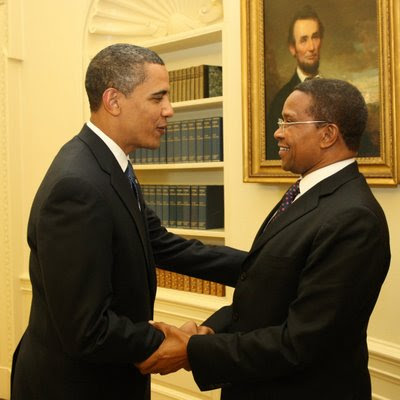 "President Obama looks forward to working closely with President Kikwete to tackle shared challenges, including the global financial crisis and its impact on sub-Saharan Africa," Gibbs said.
 The tanzania president H.E Mrisho Kikwete becomes the first African president to meet president Obama today
 The United States regards Tanzania as "a strong partner in sub-Saharan Africa." Obama's predecessor George W. Bush visited the country in February 2008.
Ndani ya liverpool


U.S. DEPARTMENT OF STATE
Office of the Spokesman
For Immediate Release May 19, 2009
2009/478
REMARKS
Secretary of State Hillary Rodham Clinton
At the Global Press Conference
May 19, 2009
Foreign Press Center
Washington, D.C.
SECRETARY CLINTON: Well, good afternoon, everyone. It’s a real pleasure to be here with you today. We believe that a free press is an integral part of our democracy. And as I said earlier this month on World Press Freedom Day, President Obama and I are determined to continue the United States’ commitment to media freedom worldwide. And I’m very proud of the State Department’s long tradition of assisting foreign journalists reporting about the United States, and we will continue to support you in your work.
I’ve just come from the White House, where I announced a new United States initiative to support the Pakistani people, their government and military as they respond to the humanitarian challenges that have resulted from their efforts to combat and defeat the extremists who are threatening their country. I am confident that Pakistan’s institutions and citizens will succeed in confronting this challenge if the international community steps up and helps.
So today, I announce that the people of the United States are responding to a request for assistance from the Government of Pakistan with more than $100 million in humanitarian support, and we are prepared to do more as the situation demands. Our assistance is already arriving. But as I said earlier, one of our guiding principles is that this should be more than just the delivery of supplies; it should be an investment in the people of Pakistan. So we will buy locally from the bumper crop of wheat, and we’ll work to help create quick impact job programs that will put Pakistanis to work making goods for their fellow citizens.
As we support Pakistan’s democratically elected government, we’re coordinating closely with United Nations, the Red Cross and Red Crescent, and we are deploying new tools. We’re working to support the Pakistani Government in launching a text messaging system that will alert local communities to assistance efforts and help keep family members in touch. We believe we face a common threat, a common challenge, and a common task. But the Pakistani people and their government have shown resolve, and it is up to us now to show our support.
Before I take your questions, let me give you just a very brief overview of some of our efforts during these first few months of the Obama Administration – how we are trying to exercise what we call smart power in pursuit of our foreign policy goals. I don’t need to tell any of you that today’s world is interconnected. Whatever country we are from, we share urgent challenges that transcend borders – climate change, food security, diseases, energy, terrorism, piracy, and, of course, the global economic crisis.
The State Department is committed to a new diplomacy powered by partnerships, pragmatism, and principle. We are elevating development to its rightful place alongside diplomacy as a key component of our international efforts. And we are working to promote good governance, human rights, and social inclusion so that more people around the world can claim their rightful share in global progress and prosperity.
Now we are using new tools and seeking new partners to broaden the reach of our diplomacy because we understand that 21st century statecraft cannot just be government-to-government; it must be government-to-people and people-to-people. So we want to engage civil society, women, youth, political activists, and others as we pursue our agenda.
Speaking about some of the specific issues that we have been concentrating on, we have been working hard to promote peace and stability in Afghanistan and Pakistan. As you know, we’ve been holding these trilateral meetings among our three countries, and our engagement in that region will continue.
We are seeking constructive solutions in the Middle East, where we have made a major commitment to assist the Palestinian people, and in Iraq, where we are working toward a responsible deployment of American combat forces. And we are taking a new approach to Iran that relies on all the tools of American power, led by diplomacy.
We are reinforcing our relationship with key allies and historic partners in Latin America, Europe, Africa, Asia, and we have engaged vigorously with a number of emerging regional actors. And we’re serious about establishing more candid, constructive relationships with both Russia and China.
In addition to our bilateral and multilateral relationships, the President and I are focused on food security so that developing nations can improve food production, affordability, accessibility, education and technology. Issues related to food, including high food prices, pose a threat to the prosperity and security of many countries. And so we are going to rebalance our programs in favor of agricultural development aid, rather than excessive reliance on emergency assistance.
Well, there’s a lot to talk about. This has been a very busy couple of months. And I appreciate the work that all of you do to report on the policies of our government and to help bring information to millions of people around the world. I hope we’ve kept you busy. But again, I am delighted to be here, and I look forward to your questions.
MODERATOR: Thank you. Madame Secretary, we’re going to take the first question from Rome on the monitor. It’s coming in from there. Hello, go ahead.
SECRETARY CLINTON: Hello, Rome on the monitor.
MODERATOR: This is Rai TV.
QUESTION: Hi. Hello, Madame Secretary. Thank you. Thank you very much for this opportunity to speak to you. So in a few weeks, Italy will host the G-8 summit in L’Aquila, the city that has been devastated by the earthquake.
First question is: What do you think of the decision to move the venue there? And the second: What the – Italy could do on international issues for helping and to be more helpful? I make two examples – first of all, would you like Italy to contribute more on troops for Afghanistan or ask to accept prisoners from Guantanamo?
SECRETARY CLINTON: Well, thank you. With respect to the first question, I thought it was a very important decision to move the G-8 summit meeting. Clearly, it serves to highlight the devastation caused by the earthquake, and it also provides an opportunity for the G-8 to inject some very needed economic assistance into the region. The United States is working with the Government of Italy to assist with respect to the reconstruction following the earthquake. We are partnering with the – a group of concerned Italian Americans, and we expect to raise money that will go toward helping the university that was devastated in the earthquake. So we see this as a way of people-to-people diplomacy and development, and playing our part in helping Italy recover from the devastation of the earthquake.
I am very grateful for the leadership and support that Italy has provided on a number of the important priorities of the Obama Administration. Italy’s assistance in Afghanistan, its renewed commitment to work with other nations on a national police force, is incredibly important and welcome. I have met a number of times with your foreign minister and with the prime minister, and we’ve discussed the full range of issues, from not only the Middle East and Iran, but to climate change, energy security, and everything you can imagine.
So Italy is playing an important role, and its hosting of the G-8, which of course will be expanded this year and will include discussions of a number of issues with nations that are not formally members of the G-8, is going to be a very important step toward bringing the world together around the resolution of these challenges. And we are grateful for the Italian leadership.
MODERATOR: We’ll go here to Constance from Nigeria. Here’s the microphone.
QUESTION: President Obama is planning to visit Africa and he will be stopping in Ghana. Is that a snub to countries like Nigeria? Why isn’t he covering more countries on this trip? And secondly, what kind of partnership and engagement do you hope to forge with the Nigerian Government and the African Union?
SECRETARY CLINTON: Well, certainly President Obama is very focused on Africa, as I am. And I hope to travel to Africa later in the year on behalf of the President and our Administration. The President’s recently announced trip to Ghana is an effort to make sure that in the very beginning of his Administration he has the opportunity to travel to not only Egypt but also another country in Africa for a visit to demonstrate our commitment to Africa. It is not meant in any other way than what I just said. It is intended to tee up what will be a continuing intensive engagement with Africa.
I view our relationship with Nigeria as an important anchor, and I believe that there is a lot of work we can do together. I have spoken on several occasions with your foreign minister, and I look forward to more consultations, because we think that Nigeria has a critical role to play in not only its own ongoing democratization and development, but also as a key actor regionally and even globally.
So I think that our commitment to Africa transcends any one country. Obviously, the President couldn't be gone long; he has to get back in order to work with the Congress on all of his priorities. But he really wanted to make a stop in Africa that would send a message in Sub-Saharan Africa of his commitment to all of the nations there. And we will follow up very specifically on our agenda with Nigeria and other nations as well.
MODERATOR: We’ll go back for Australia, Geoff Elliott.
QUESTION: Thank you, Madame Secretary, for this opportunity. I’m just wondering, Australia recently released its defense white paper, and in sum, it basically charted the rise of China and the potential decline of the U.S. as the sole dominant force in the Asia-Pacific region in the years ahead. I’m just wondering how you see the U.S. partnering with Australia in the future. Is it sort of business as usual between old mates, to use the local vernacular, or is there a case where the Australia-U.S. partnership needs to evolve over time, given that our economic interests seems to be increasingly allied with China?
And one quick one, if I may. The Bush Administration also made a specific request of Australia to accept Uighur detainees from Guantanamo, and I’m wondering if you’ve made a similar request. Thank you.
SECRETARY CLINTON: Well, first let me say that our relationship with Australia is strong and enduring. We have both had recent changes of government. The underlying partnership remains very solid. But obviously, we are going to engage in a somewhat different way than our predecessor did, and I think it’s fair to say Prime Minister Rudd and his government are as well. We had an exceptionally successful visit from the prime minister. My counterpart, Secretary of Defense Bob Gates, and I had a really constructive, productive meeting with your foreign minister and defense minister.
I think that we are deepening and broadening our engagement. We don’t think it’s a zero-sum game. The fact that a country like China is becoming more successful or Indonesia is now a very successful democracy, we see that as to the good for the entire Pacific region. But we also are sending a clear message that the United States will be engaged. We are a transpacific power as well as a transatlantic power. My first visit as Secretary of State, as you know, was to Asia. We are going to have a very positive engagement on a range of issues with Australia, and we’re going to look for ways of enhancing our cooperation when it comes to regional security.
But we want Australia as well as other nations to know that the United States is not ceding the Pacific to anyone. We have longstanding bilateral relationships with nations like Australia and others, and we have a very active multilateral agenda that we intend to reinvigorate, such as our membership in ASEAN and other fora within the Pacific region.
So I believe that the assessment that is made about the future of Asia should include a very active partnership between Australia and the United States on behalf of security and stability and economic growth and prosperity, and we intend to work together to achieve that.
With respect to your other question, we obviously are very hopeful that a number of nations will assist us in delivering on the President’s commitment to close Guantanamo. And that will require the release and placement of a number of the detainees.
MODERATOR: We’re going to go to our New York Foreign Press Center, and from Pakistan, Shafiq Saddiqui.
QUESTION: Thank you. My question is the weapons in possession and in use by the insurgents in Pakistan are modern and sophisticated. The level of resistance shows the continuation of their supply line. Can America not find, detect, and destroy the supply line of weapons to Taliban? Second part of my question is: Can America not find out who is supplying the weapons to Taliban?
SECRETARY CLINTON: Thank you. I think it is important to underscore our very strong support for the steps that the people, government, and military of Pakistan are taking against the extremist threat that is not only aimed at Pakistan, but clearly beyond the borders to other nations as well.
And yes, we know that the extremists are being supplied. We are working closely with the intelligence services of Pakistan and other countries to try to determine where those weapons are coming from. And we are certainly supporting the Pakistani Government in their efforts to disrupt the supply lines that are providing the weapons.
As you know better than I, this is a very difficult terrain to operate in. Many of the extremists are aided by local residents who know every trail and every possible route into the areas of conflict. So it’s a challenge, but it’s one that we are supporting the Pakistani military in addressing.
And with respect to the specifics of going after those who are supplying them, I’m sure that when information is available and credible, the Pakistani Government will do what it must. And we stand ready to offer assistance if they request.
MODERATOR: Come back here to Washington. And we have Mitch Potter from Canada.
QUESTION: Thank you very much.
SECRETARY CLINTON: Hello.
QUESTION: Madame Secretary, there is a persistent myth, despite all evidence to the contrary, that Canada was a gateway for the 9/11 bombers. Canadian officials are vexed and frustrated by this. They say that it’s been fed by many sources, including comments that were attributed to you when you were a senator.
So my question for you today is to ask for clarity. Are Americans right to worry about the Canadian border more than any other point of entry when it comes to security concerns? And if the answer is no, perhaps you can help us understand why these perceptions are so entrenched.
SECRETARY CLINTON: Well, let me say that Americans are worried about every port and point of entry. I don’t think we have any lesser concern about any other route into our country than any other one. Obviously, we’re proud of the long, peaceful border that we share with Canada. But I think it is fair to say that since 9/11, we have been working with our friends in Canada to try to harden that border, to try to provide both more personnel and technology. The prior administration worked on that with the Canadian Government. Our Department of Homeland Security will continue to do so.
As you alluded, I represented New York for eight wonderful years, and our border was pretty porous, just to be blunt. And it had never been a problem before. We had both land and water points of entry that had been traditionally used without any questions being asked. And unfortunately, given the security environment that we have to deal with today, we have been focused on making sure that our northern border was as secure as possible without undermining either our relationship, or the trade in goods and services, the tourism, the natural flow of people who both work and go to school and recreate on both sides of the border.
But I think that the Canadian Government and the United States Government are both focused on this and have worked very hard together over the last years.
MODERATOR: We’re going to go back to New York. And we have from Poland, Tomasz.
QUESTION: Madame Secretary, there was an independent study published today by East-West Institute that says that the missile shield in Europe would be ineffective. And also the Department of Defense has just cut spending on this project. So I wanted to ask you about a political aspect of this project. Do you still plan to build anything in Europe and in Czech Republic, or you want to abandon this project?
SECRETARY CLINTON: Well, let me say, first of all, I have not had a chance to read or review the study that you have just mentioned. I saw news reports, but that’s all I’ve seen of it. The Obama Administration is engaged in our own strategic review with respect to missile defense. We are not yet finished with that review, but we are looking at it from all angles.
But let’s remember what is really at stake here, especially when it comes to friends and allies like Poland and the Czech Republic. The United States takes very seriously our Article 5 responsibility under NATO to protect and defend the security and sovereignty of our fellow allies. Since I have been Secretary of State, I have pushed hard for NATO to be sure that we have all the contingency planning done that is necessary to make good on our Article 5 commitment.
The idea behind missile defense was to help both deter and defend against attacks from nations like Iran were they to obtain nuclear weapons with systems of delivery. So we will obviously take into account the technical aspects of this in our review, but we’ll also be taking into account our preexisting and continuing responsibilities to our friends and allies. And I will assure you that the United States is fully committed to the defense of Poland and our other allies within NATO.
MODERATOR: And Joyce Karam from pan-Arab media.
QUESTION: Yes, hi, Madame Secretary. Thanks for doing this. I want to ask you about the peace process. President Obama has stated yesterday that he would like to see a settlement freeze. Do you personally believe that this will actually happen, given that it has been requested so many times in the past and it never happened on the ground?
And if I could just – I feel I have to ask you about this. The Kuwaiti elections in the Arab world, we have seen four women break the glass ceiling, as you like to say, and made it to the parliament, if you can comment on that as well.
SECRETARY CLINTON: Thank you. I think the President was very clear yesterday in his statement that he wants to see a stop to the settlements. I hosted a dinner for Prime Minister Netanyahu later in the day at the State Department, and we reiterated that that is the position and policy of the United States Government.
We are committed to a two-state solution, and obviously, underlying that commitment is the conviction that the Palestinians deserve a viable state. And therefore, nothing should be done to undermine the potential resolution of the peace effort that could prevent such a two-state solution from taking hold. We are, as always, committed to the safety and security of Israel, but our goal is to see the people living together. We want to see Israelis and Palestinians having a chance to raise their children, to have a future free of conflict, and to give every child the opportunity to fulfill his or her God-given potential. That is our goal.
So we are at the beginning of what will be an intensive period. And you noticed that we started it right from the commencement of the Obama Administration. We appointed George Mitchell as our Special Envoy the second day of the President’s term in office. We have worked very hard already to determine what is possible. And it’s not only, as you know, what the Israelis and the Palestinians will do, but what will the Arab neighbors do, what will others do to help us bring about the conclusion we seek?
And let me just say with respect to the Kuwaiti elections how pleased I am. I started working with a group of courageous Kuwaiti women back in the 1990s, and encouraged their commitment to democracy and their desire to see women included in the growing democracy in their own country. And the election on Saturday is a watershed event. These four women were elected without the support of a political party and without any quota requiring that women be elected. I really congratulate the people of Kuwait, and particularly the Amir and the leadership.
Because you know how I feel: No country will be successful if half the population are denied their basic rights to participate and to lend their talents, their energy and their intelligence to the development of their countries. And so this is, for me, an incredibly important step along the path of seeing the full inclusion of women in their societies across the world.
MODERATOR: Madame Secretary, clearly, they’d like to keep you here a couple more hours, but we know your time is (inaudible) – so we would hope you would come back. She’s going to have to go. She has a very busy schedule. But hopefully she’ll be back.
SECRETARY CLINTON: Oh, I’m so sorry. I would love to stay.
BREAKING NEWS!
Dr. Harrison Mwakyembe, mbunge wa Kyela amepata ajali ya gari leo asubuhi


 Dr william shija with prof miriam were


Dr. Harrison Mwakyembe, mbunge wa Kyela amepata ajali ya gari leo asubuhi

 Dr william shija with prof miriam were


http://www.youtube.com/watch?v=2aAIlSyiHkk
CRED Annual Lecture.11th June 2009, 6p.m. to 7.15."What Love has to do with it?: Sexuality, Work and Power in Caribbean Gender Relations"Professor V. Eudine Barriteau, University of the West Indies.
The Lecture is followed by a reception with an African flavourClinical Lecture Theatre,Francis Bancroft Building,Queen Mary, University of LondonMile End, London EC1 4NS
In this lecture Professor Barriteau applies Anna Jonasdottir’s construction of ‘love power’ towards developing a theory of sexuality and power in the contemporary Commonwealth Caribbean using Barbados as a case study. She engages in a triple play on the meanings of the word ‘coming’ and anchors these meanings to black feminist theorising of the concept of ‘home’ (Barriteau 2006: 21-22; Carby 1997: 47; Smith 1983: 64-72). Barrieteau explores some of the complications romantic loving pose for Caribbean women. She is particularly interested in revealing the continuities between ongoing attempts to subordinate women and the sense of powerlessness that often arises in women’s heterosexual, socio-sexual unions. I attempt to track how these complications become extrapolated into wider systemic inequalities, (especially in conditions of work and employment), even as these are simultaneously reflected back onto the individual relationships and their representations of gendered hierarchies of power and inequalities.
Barriteau foregrounds her analysis in the centrality of work in Caribbean women’s lives, as they navigate the intersections of the public and the private, production and reproduction. Her challenge is to work backwards and forwards from the dynamics of that basic union (played out in private, intimate spaces such as the home), to contemporary developments in Caribbean political economy.
Violet Eudine Barriteau is Professor of Gender and Public Policy of the University of the West Indies. She is Deputy Principal at the Cave Hill Campus, Barbados and was the first Head of the Centre for Gender and Development Studies, Nita Barrow Unit. Professor Barriteau has been awarded numerous academic scholarships and awards.
Contact: Professor Geraldine
Thursday, 21 May 2009
The day i checked out cultural diversity in Eritrea


CRED Annual Lecture.11th June 2009, 6p.m. to 7.15."What Love has to do with it?: Sexuality, Work and Power in Caribbean Gender Relations"Professor V. Eudine Barriteau, University of the West Indies.
The Lecture is followed by a reception with an African flavourClinical Lecture Theatre,Francis Bancroft Building,Queen Mary, University of LondonMile End, London EC1 4NS
In this lecture Professor Barriteau applies Anna Jonasdottir’s construction of ‘love power’ towards developing a theory of sexuality and power in the contemporary Commonwealth Caribbean using Barbados as a case study. She engages in a triple play on the meanings of the word ‘coming’ and anchors these meanings to black feminist theorising of the concept of ‘home’ (Barriteau 2006: 21-22; Carby 1997: 47; Smith 1983: 64-72). Barrieteau explores some of the complications romantic loving pose for Caribbean women. She is particularly interested in revealing the continuities between ongoing attempts to subordinate women and the sense of powerlessness that often arises in women’s heterosexual, socio-sexual unions. I attempt to track how these complications become extrapolated into wider systemic inequalities, (especially in conditions of work and employment), even as these are simultaneously reflected back onto the individual relationships and their representations of gendered hierarchies of power and inequalities.
Barriteau foregrounds her analysis in the centrality of work in Caribbean women’s lives, as they navigate the intersections of the public and the private, production and reproduction. Her challenge is to work backwards and forwards from the dynamics of that basic union (played out in private, intimate spaces such as the home), to contemporary developments in Caribbean political economy.
Violet Eudine Barriteau is Professor of Gender and Public Policy of the University of the West Indies. She is Deputy Principal at the Cave Hill Campus, Barbados and was the first Head of the Centre for Gender and Development Studies, Nita Barrow Unit. Professor Barriteau has been awarded numerous academic scholarships and awards.
Contact: Professor Geraldine Healy
Wednesday, 20 May 2009
The day i checked out the cultural diversity of zimbabwe


Mbote/Jambo/Salut Virunga fans!
Just posted today: a fantastic write-up by RFI reporter Bertrand Lavaine on Samba's career and his latest Live on Tour digital album, complete with a sound clip of "Malako." These links go to the English language pages; there are also pages with the same stories in French.
the article:
http://www.rfimusique.com/musiqueen/articles/113/article_8212.asp
the record review:
http://www.rfimusique.com/musiqueen/articles/113/article_8213.asp
Links to French pages:
http://www.rfimusique.com/musiquefr/articles/113/article_17620.asp
http://www.rfimusique.com/francais/musique/articles/113/article_17621.asp
Great job, bien fait, and big asante sana to Bertrand and RFI!
Virunga Oye!
CC Smith
Virunga Management
818-247-1707
www.myspace.com/sambamapangala
http://www.eastafricanmusic.com/mapangala.htm
http://cdbaby.com/cd/mapangala6
http://zanzibarorbust.blogspot.com/
NASA Supercomputing Goes Green: Modeling Ocean ClimateSun, 17 May 2009 23:00:00 -0500
Earth scientists are reaping huge benefits from research performed on NASA's advanced supercomputers
Hello all,
My name is Lawrence Ross and I'm the author of The Divine Nine: The History of African American Fraternities and Sororities. My book has been a bestseller among college students in the US for the past decade, and as a result, I've lectured at over 300 universities. African American fraternities and sororities have been the incubator for young African American leadership since the early 20th Century, producing such members as Reverend Dr. Martin Luther King, Jr., Jesse Jackson, Nikki Giovanni, Toni Morrison, Bill Cosby, and thousands of others. Our chapters are not only in the US, but also in Germany, South Korea, and the Caribbean. I'm emailing because one of my fraternity brothers is a lawyer in London, and he's been trying to get me to speak on college campuses in the UK during October. I have an honorarium, so he's thinking about matching sponsoring corporations with universities/ student groups who would like to hear about our organizations (particularly since many black fraternities and sororities are thinking of expanding into the UK). If you're interested in having a Divine Nine lecture, please contact me asap. It's going to take a bit to set everything up, but I'd like to be able to speak to as many students as possible. Thanks!-- Lawrence C. Ross, Jr.The Divine Nine: The History of African American Fraternities and Sororities
Tuesday, 19 May 2009


Hubble Servicing Crew to Hold News Conference from Space
HOUSTON -- The seven astronauts aboard space shuttle Atlantis will hold a news conference at 9:26 a.m. CDT on Wednesday, May 20, to discuss their mission to upgrade the Hubble Space Telescope. Reporters may ask questions from NASA's Johnson Space Center in Houston, Kennedy Space Center in Florida, Goddard Space Flight Center in Greenbelt, Md., and NASA Headquarters in Washington. To participate in the news conference, U.S. journalists must call the public affairs office at one of the NASA centers listed above by 1 p.m. Tuesday. Media representatives must be present at participating locations at least 20 minutes prior to the start of the news conference. NASA Television will provide live coverage of the 40-minute event. For NASA TV downlink, schedule and streaming video information, visit:
http://www.nasa.gov/ntv
During Atlantis' STS-125 mission, the crew has completed work to improve Hubble's view of the universe with the addition of two new science instruments, the repair of two others and the replacement of other hardware that will extend the telescope's life at least through 2014. For more information about the STS-125 mission and its crew, visit:
http://www.nasa.gov/shuttle

Under-fire Speaker to step down
Michael Martin organised a meeting to create proposals over MP expenses
Michael Martin is set to announce he will stand down "soon" as Speaker in a Commons statement to MPs at 1430 BST.
Mr Martin has been criticised over his handling of the furore over MPs' expenses and a motion of no confidence in him has been backed by 23 MPs.
It will be the first time in 300 years that a Speaker has effectively been forced out of office.
Meanwhile Gordon Brown said no Labour MP who broke expenses rules would stand at the next election.
And former Conservative minister Douglas Hogg has said he will stand down as an MP at the next general election.
He has already agreed to repay £2,200 - the cost of clearing a moat at his country estate - which had been on paperwork submitted to the Commons fees office in support of his claims.
'Profoundly sorry'
Tory backbencher Douglas Carswell - who put forward the motion of no confidence in Mr Martin - said the Parliamentary system had fallen into disrepute with many MPs being seen as "parasites" over the expenses scandal.
But he told the BBC: "Removing Michael Martin is not the end, it is the beginning - a new Speaker has to be reformist, they need to be progressive."
Mr Martin, the MP for Glasgow North East and Speaker since 2000, is due to meet party leaders later to discuss interim reform proposals for MPs' expenses.
A spokeswoman for the Speaker confirmed Mr Martin was making a statement this afternoon "about himself" and would be going ahead with the meeting at 1630 BST.
His resignation will be the first step in the House recovering its reputation
David WinnickLabour MP
Q&A: Speaker set to quit
How will new Speaker be chosen?
Speaker: Runners and riders
Asked whether the Speaker had resigned the prime minister's official spokesman said: "That is a matter for the Speaker."
Mr Martin's critics say he was the driving force behind repeated attempts by Commons authorities to block details of MPs' expenses from coming out under Freedom of Information legislation.
He was also criticised for attacking MPs in the Commons who had campaigned for more transparency or questioned his decision to call police to investigate the leaking of expenses details to the Daily Telegraph.
On Monday Mr Martin said he was "profoundly sorry" for his part in events but did not give any indication of - or timescale for - any plans to stand down.
'Status quo'
He was challenged by a succession of MPs who stood up to ask when they could debate a motion of no confidence in him.
Liberal Democrat leader Nick Clegg had openly called for him to go - calling him a "dogged defender of the status quo".
Prime Minister Gordon Brown and Tory leader David Cameron had said it was a matter for the House of Commons - not the government or official opposition.
"I think the turning point for the Speaker in his own mind would have been the order paper today which had stark reading about a vote of no confidence
Sir Stuart BellLabour MP
Angry MPs turn on Commons Speaker
Salmond calls for early election
Labour MP Sir Stuart Bell, a member of the ruling House of Commons Commission, said he hoped MPs would respect what Mr Martin had to say and recognise his "great service" to Parliament.
"I think the turning point for the Speaker in his own mind would have been the order paper today which had stark reading about a vote of no confidence - and reading today's newspapers, building up on what happened yesterday, I think made his statement inevitable," he said.
"But he is determined to see through the reforms that he announced yesterday."
He also said reforms approved at the cabinet meeting earlier - to put independent regulators in charge of the Commons - meant the role of the Speaker would change.
"There will no longer be a Speaker who is in charge as chief executive of the House of Commons. He will be procedural and ceremonial - so when we do look for a new Speaker it will have to take that into account."
'Undesirable precedent'
Mr Carswell's motion of no confidence in Mr Martin was put on the order paper on Tuesday.
But former Tory minister Peter Bottomley had tabled an amendment, saying that the Speaker himself is "best placed to decide when to retire from office".
Mr Bottomley told the BBC it would have set an "undesirable precedent" if the issue had gone to a debate and it was right he should be able to announce his own retirement.
Labour MP David Winnick, who was among those asking Mr Martin to take early retirement on Monday, said: "That is the right and honourable course to take. His resignation will be the first step in the House recovering its reputation."
However fellow Labour MP Austin Mitchell said he had been the victim of a Conservative "witch hunt" and he hoped Mr Martin would not stand down until the next general election. "It's not his fault," he told the BBC.
Labour's former Health Secretary Frank Dobson said most MPs had backed efforts to keep the expenses system secret.
He told the BBC: "I think it is a dreadful example of the House of Commons as a whole - which as a whole is responsible for the mess we are in - trying to scapegoat one man who was trying to represent what he thought were their views on what should be done." [source bbc]
Saturday, 16 May 2009

· Prime Minister Brown assures African parents
· How did British-born Nigerian become pregnant in jail?
· Queen of England commends Ghana
· The Metropolitan Police Service are recruiting
· The rise and rise of the Kenyan Youth Choir
· The return of Issa Bagayogo
· The Awka kidnappings
· A guide to Fostering. ... and more
Links to your favorite publication are further down in this email.
Trumpet Newsbreaker
Starting or Running a Newsletter, Newspaper or Magazine?
Do you intend starting a Newsletter, Newspaper, Magazine or any publication for that matter, but don’t know where to start?
Have you started your publication already but can do with some tips on how to run and manage the publication to achieve success?
Do you just need a sounding board to make sure your idea is practicable and realistic and is heading for success?
Are you battling against the recession and need some tips to survive, thrive and flourish?
Are you worried about the news around the world about job cuts, declining sales and advertising revenue and collapse of Media Houses?
Then one of our workshops might just be what you need.
Come and share in the experiences of award-winning ‘Femi Okutubo – Publisher of The Trumpet Newspaper, Trumpet Lifestyle Magazine and Trumpet Digital.
Femi started The Trumpet 14 years ago and today, it is Britain’s largest distributed Black publication. The Trumpet made headline news in 2001 when it beat other competitors including The Voice and New Nation to become Britain’s largest distributed ABC-Audited Black publication.
For further details on how to book on to one of our Workshops currently scheduled for UK, Nigeria, Ghana and The Gambia, please Email: info@the-trumpet.com or Telephone +44 (0) 20 8522 6600 or +44 (0) 7956 385604.
Do you need to give your event that extra touch of class?
Do you need a versatile and experienced hand to anchor your event?
Our areas of expertise include:
· Keynote Addresses
· Pre-Dinner and After-Dinner Speeches
· Words of Motivation and Inspiration
· Event Management
· Master of Ceremony for various event types
· Image and Brand Management
To book award-winning and God-gifted ‘Femi Okutubo for your next event, please
Email: events@the-trumpet.com or Telephone +44 (0) 20 8522 6600 or +44 (0) 7930 307107
It gives us great pleasure to send you Issue 236 of The Trumpet Newspaper.
To open, please click on the picture above or the link below:
The Trumpet Newspaper Issue 236 (May 6 - 19 2009)
Or copy this address into your web browser:
http://content.yudu.com/Library/A17pgf/TheTrumpetNewspaperI
Subscribe to:
Posts (Atom)